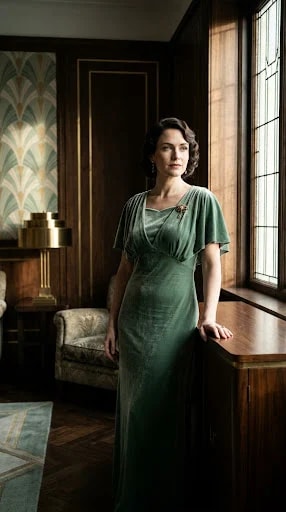
A woman in a flowing green gown leans against a mahogany sideboard, and the room holds her completely. Dark paneling runs to the ceiling, wallpaper fans out in green and gold behind her, a geometric brass lamp waits on the sideboard, and light falls in from a tall leaded window on the right. Nothing in the frame is shouting. That is the whole lesson of 1930s home decor style: glamour achieved through restraint, deep color and materials that reward a second look.
The palette does most of the work. Forest green rather than sage, warm brown rather than gray-brown, and gold kept muted and slightly aged instead of bright and polished. In practice, choose one saturated green for a wall, a velvet chair or a large cabinet, then let wood tones carry the rest of the room. Mahogany and walnut give the period its particular warmth because their red-brown undertones flatter green instead of fighting it. Treat metallic accents as punctuation, not vocabulary: a lamp base, a mirror frame, a row of drawer pulls, and then stop.
Texture is what separates a genuine 1930s room from a costume. The decade loved surfaces that caught light differently from one another, and this interior layers them deliberately: velvet on the gown and the armchair, lacquered brass on the lamp, leaded glass in the window, and flat veneer on the sideboard. Reproduce that density with three or four materials in one sightline. A high-sheen object next to a matte one next to something woven reads as depth; five glossy pieces read as a showroom.
Pattern needs a clear hierarchy. The fan motif wallpaper is the loudest element in the room, so the armchair beneath it runs a smaller, quieter repeat and the paneling stays entirely plain. Pick one hero pattern, ideally something geometric or fan-shaped, and let everything around it breathe. If wallpaper feels like too much commitment, put the motif on a screen, a rug or a pair of cushion covers and keep the walls in a single deep tone.
Finally, work with the light you actually have. The soft shadows falling from that window are half the mood, and heavy drapery would flatten them. Keep window treatments simple, add a warm bulb to the brass lamp for evenings, and leave one piece in the room obviously modern so the space feels lived in rather than preserved. The result is nostalgic without being a museum, which is exactly the balance the 1930s struck.