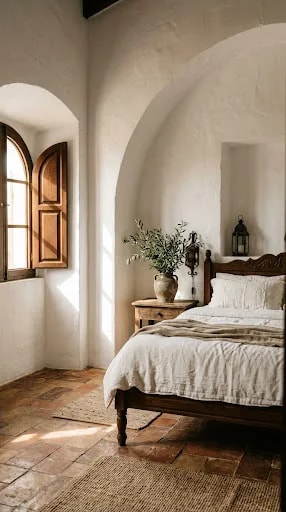
The window does most of the work in this room. An arched opening frames a wall of green foliage, and because the frame is narrow and the glass is nearly uninterrupted, the garden reads less like a view and more like a second wall of the bedroom. Morning light arrives warm and slightly diffused, sliding across the floor tiles and softening the edges of everything it touches. Notice how little is placed in front of it. That emptiness is deliberate: in a Mediterranean bedroom, the architecture is the decoration, and anything set against the arch risks competing with it.
The bed itself is a study in lightness. A slender wrought-iron canopy holds four panels of sheer white fabric, gathered loosely rather than tied back with precision. The metal gives structure without bulk, and the curtains filter rather than block, so air still moves through the room on a warm night. This is the quiet genius of the iron four-poster in this style: it borrows the romance of a grand canopy bed while staying thin enough to disappear against white walls. Choose a frame with simple joints and a matte finish, skip the heavy top valance, and let the fabric puddle just slightly where it meets the floor.
Underfoot, the terracotta tiles set the temperature of the whole scheme. Their earthy orange-red keeps crisp white linens from feeling clinical and picks up the warmth of the sun. If you are working with a cooler or more neutral floor, a flat-weave rug in clay or faded rust can do the same job without visual noise. Walls should stay chalky and matte, in limewash or a soft plaster finish, so shadows land gently instead of bouncing off a hard surface. The palette is short on purpose: white, terracotta, a breath of green from outside. Texture carries the interest that color usually would.
A few practical moves make the look liveable rather than staged. Keep window treatments to linen or cotton voile with a simple rod, since a heavy drape would kill the light that makes the room. If your ceiling is low, drop the canopy top or choose a headboard-only iron frame; the vertical lines still read. Repeat the arch somewhere small, in a mirror, a niche, or the curve of a bedside lamp, so the motif feels intentional rather than accidental. Resist the urge to fill the walls. One ceramic vessel, one woven basket, and a single potted olive near the door will hold the composition together.
What stays with you is the pace of the room. Sheer fabric moving in a draft, sun on tile, a green view held inside a curve of plaster. It is a bedroom designed for slow mornings and long afternoons, where the door to the garden is never quite shut and the line between inside and out stays pleasantly blurred.