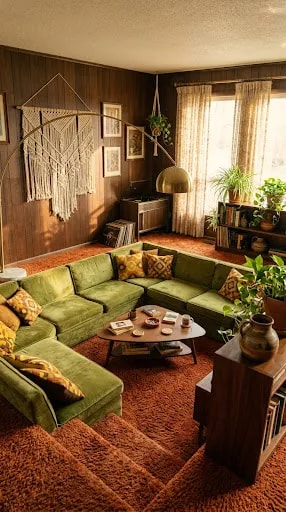
If you want to understand why the 1970s keep returning to interior design, stop looking at the furniture and start looking at the light. In this living room, afternoon sun rakes in from the right, catching the nap of a rust-orange shag carpet and the velvet pile of an olive-green sectional before fading into wood-paneled walls. Almost nothing in the frame is neutral in the strict sense — even the cream sheer curtains carry a little warmth — and that is precisely the point. The decade's palette was built on colors that behave like textures, shifting from green to brown to gold as the day moves across them.
Avocado is the hardest sell and the biggest payoff. People hear the word and picture a refrigerator, but on a deep sectional in a soft velvet, that green reads as an earthy neutral — closer to moss or olive than to appliance enamel. It absorbs light rather than reflecting it, which makes a large room feel grounded and a small one feel enveloping. The trick is to keep the finish matte and the silhouette simple: clean arms, a low back, no skirt. Let the color do the talking and skip the tufting.
Rust is the accent that keeps all that green from going flat. Here it arrives in the carpet, a bold move most of us will not repeat, but the logic translates: put the warm orange where feet and hands meet it, in a wool rug, a stack of patterned throw pillows, a ceramic lamp base, a tray on the oval coffee table. Brass belongs in the same conversation. The arc floor lamp sweeping over the seating area works because it is thin and dark against the sunlit wall, adding a metallic glint without adding visual weight. If you are layering in brass, repeat it two or three times — hardware, lamp, frame — so it reads as a deliberate thread.
What holds the whole scheme together is texture, not objects. Macramé on the wall, shag underfoot, velvet on the seat, cane or walnut on the shelves, a trailing houseplant softening the corner, a stereo console doing quiet duty as a sideboard. The 1970s understood that a room can be busy and still feel calm if every surface has something to touch. Carpeted steps down into the seating area reinforce it: the floor itself becomes upholstery.
You do not need the sunken pit or the paneling to borrow this. Choose one anchor color in a fabric you want to live with, one warm accent in something small and replaceable, and one metallic finish repeated three times. Then leave a little air — bare wall, sheer curtain, an empty stretch of rug — so the warmth has somewhere to breathe. The decade's real lesson is not nostalgia. It is that color, texture, and low golden light will make a room feel inhabited faster than any amount of good taste.