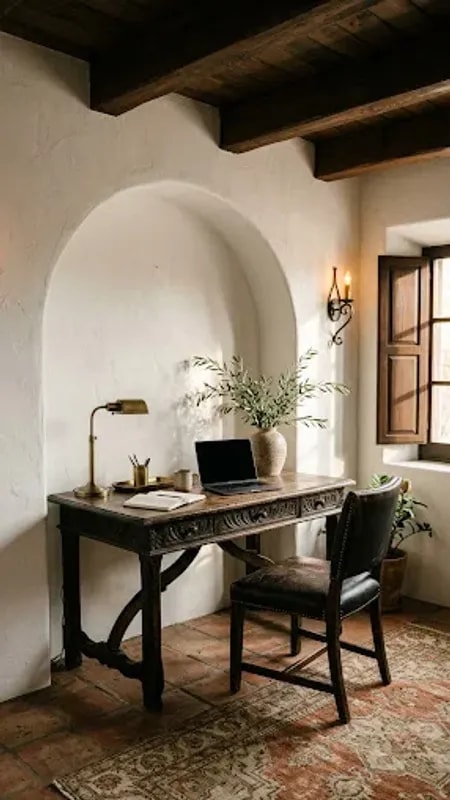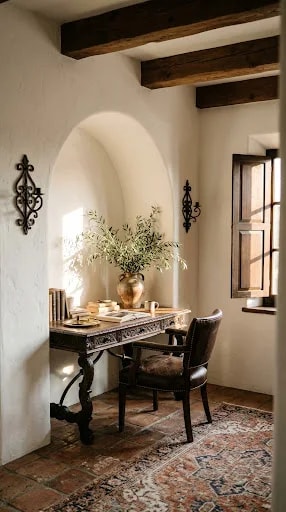
Some workspaces announce themselves with glass and cable trays. This one whispers instead, tucked into a rounded plaster arch as if the room had simply decided to keep a desk there. The walls are hand-troweled and slightly uneven, catching the afternoon light in soft bands, and the arch frames the whole scene like a painting you happen to sit inside. It is the kind of corner that makes an hour of focused work feel less like a task and more like a small retreat.
The desk does most of the talking. It is dark, heavily carved wood, the sort of piece that carries a few generations of scratches and doesn't apologize for them. Against those pale, chalky walls the contrast is everything: heavy against light, shadowed against sunlit, formal against rustic. A leather chair pulls up close, softening the silhouette, and the brass vase of olive branches on the desktop adds the one thing this palette needed most, a loose, living green that refuses to sit straight. Books, a notebook, a small tray of pens — the accessories stay sparse so the carving can be read.
Lighting does the quieter half of the work. Wrought-iron sconces flank the arch, their blackened scrolls reading as ornament by day and as glow by night. Above, exposed timber beams cross the ceiling, and at the right a small shuttered window lets in a narrow shaft of warm sun that grazes the plaster and slides across the desk through the afternoon. That single source is enough. Spanish-style rooms rarely want even, bright light; they want the drama of a warm edge and a deep shadow beside it.
Underfoot, terracotta tiles bring in the earthy red that ties the scheme together, partly covered by a patterned rug in muted rust, blue, cream, and brown. The rug is what keeps the corner from feeling like a museum display, softening the tile and giving the chair something forgiving to roll against. If you are rebuilding this look at home, work in this order: a textured wall finish, one substantial wooden desk, a warm metal accent in brass or iron, and a single large branch arrangement rather than a cluster of small plants. Keep the palette to warm white, dark wood, olive green, and one earthy red.
The lesson of the arch is scale. A workspace doesn't need a whole room to feel considered — it needs a boundary, a material story, and a reason to look up. Here the boundary is plaster, the story is wood and clay and iron, and the reason to look up is a shuttered window letting in just enough Spanish afternoon.