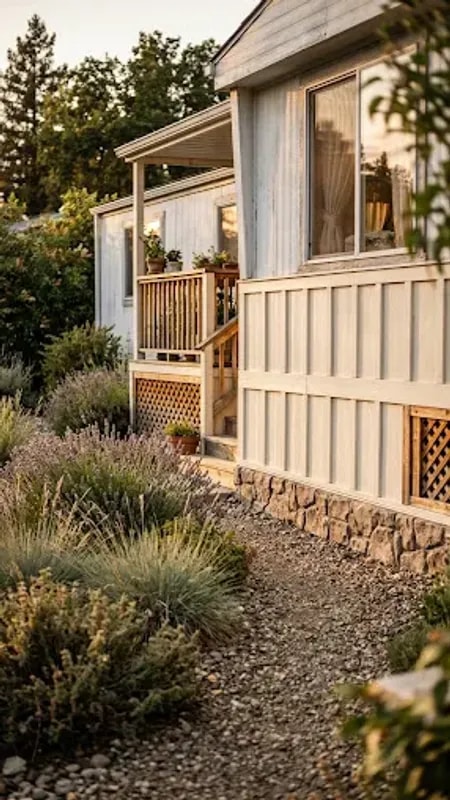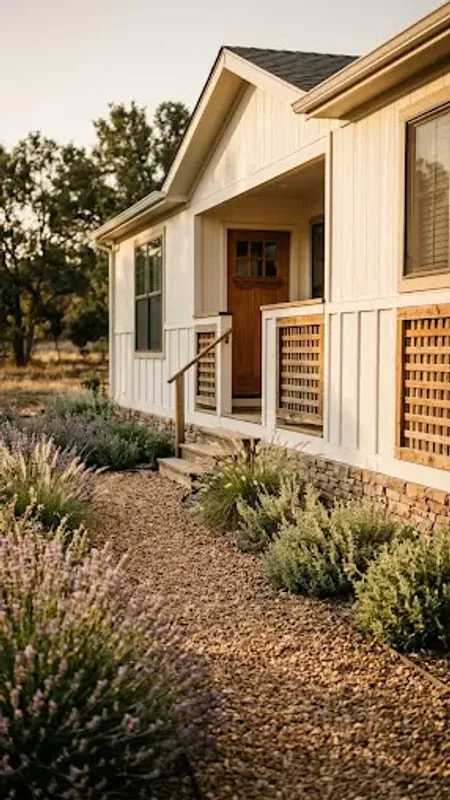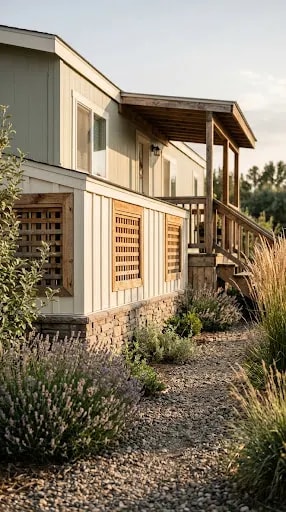
Most skirting conversations start at the house and stop at the house. This one starts eight feet out, on a gravel path that curves toward the porch and asks your eye to travel slowly. That slow approach is what makes the base of this home feel intentional rather than closed off. The skirting is doing structural work, sure, but it is also doing choreography: cream vertical siding steps down into rustic stone blocks, framed wood-lattice panels break the run, and the path keeps pulling you past lavender and ornamental grasses until the porch posts finally arrive.
The material stack is the quiet hero. Above, the home wears cream board-and-batten siding, warm and slightly honeyed in late light. Below, weathered stone blocks in gray and tan take over at exactly the height where the eye would otherwise notice a shadow line or a vent panel. Between the two, framed lattice inserts read as small architectural windows rather than leftover utility panels. Each panel is boxed in stained wood, so the lattice has a border, a beginning and an end. That single framing detail is the difference between skirting that looks finished and skirting that looks like a home improvement aisle purchase.
What sells the farmhouse read, though, is the ground. Loose gravel in a soft buff tone meets the stone without a hard seam, and the plantings spill forward in deliberate layers: low shrubs at the front, ornamental grasses for movement, a drift of lavender for color and scent. Nothing is clipped into tight balls. The looseness signals that this is a working garden, not a display. If you are borrowing this idea, treat the first eighteen inches in front of your skirting as part of the design budget. A mounded row of mulch alone will always look thin next to stone.
Light does the rest. Golden hour rakes across the verticals of the siding, the texture of the stone, and the grain of the porch posts, so three materials that could have clashed instead share a warm palette of cream, honey brown, and weathered gray. Paint and stain choices matter more than you might think here: keep the siding a soft off-white rather than a bright white, let the lattice go a shade darker than the porch floor, and choose stone with some tan in it so the base does not turn cold blue in shade.
If your budget only stretches to one upgrade this season, make it the transition. A framed lattice panel or two, a stone-look base in a warm neutral, and a curved gravel edge with three or four generous plantings will do more for a manufactured home's presence than a whole new set of shutters. The goal is not to hide the base. It is to give a visitor something pleasant to walk beside on the way to the door.