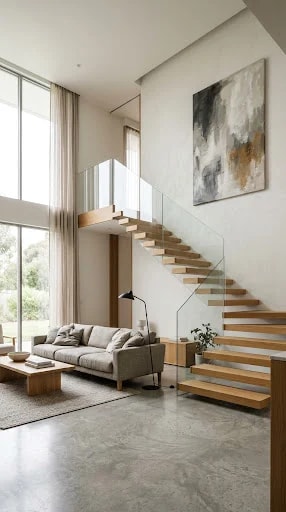
In contemporary home design, the staircase has stopped being a piece of circulation and become the room's quiet protagonist. Look at a double-height living space anchored by light oak treads that appear to hover, held by a clear glass balustrade, and you understand the shift. Nothing about the stair shouts. It simply lifts the eye from the low gray sofa through two storeys of open air, and in doing so it organizes everything else around it: the pale rug, the low wooden coffee table with its stack of books, the slim black floor lamp that marks the edge of the seating zone without blocking a single sightline.
The floating tread is a trick of restraint. By removing the risers, the heavy stringers, and the solid guardrail, the design lets daylight from the floor-to-ceiling windows travel across the room uninterrupted. Sheer curtains diffuse the light on the left so it lands softly on concrete-gray walls and warm beige upholstery, and the glass balustrade keeps the vertical plane almost invisible. Light oak is the right choice here because it introduces warmth without adding visual weight, echoing the console below and the muted greens of whatever garden sits outside the glass.
What makes the composition work is proportion rather than decoration. The stair rises through the tall volume like a drawn line, and the large abstract painting in gray, white, and ochre holds the opposite wall so the eye has somewhere to rest. A small potted plant supplies the only saturated color. Notice how the furniture stays low and horizontal: a long sofa, a flat coffee table, a slender lamp. Every object below is deliberately ground-hugging so the stair can do its vertical work. In a room like this, a tall bookshelf or a chandelier would fight the architecture and win nothing.
There are practical rewards too. Open treads let warm air circulate in a double-height space and keep the stairwell from feeling like a shaft. Glass panels are easier to keep bright than timber balusters, and they preserve the sense of a single continuous room. If you are planning something similar, treat the stair as a piece of furniture you would choose carefully: decide the wood tone first, match the tread thickness to your interior trim, and keep the balustrade detail as minimal as your building code allows.
Contemporary style, at its best, is not about adding a statement. It is about removing the clutter that hides good proportions. A floating staircase in oak and glass earns its place because it does three jobs at once — it moves people, it moves light, and it gives a tall, calm room its unmistakable vertical rhythm.