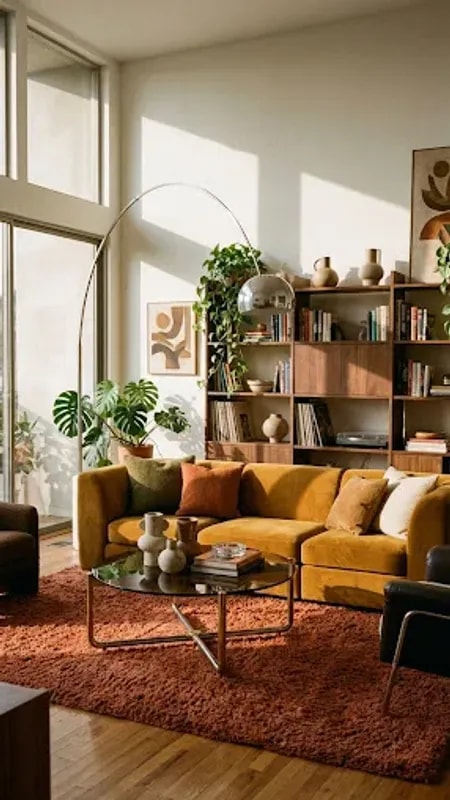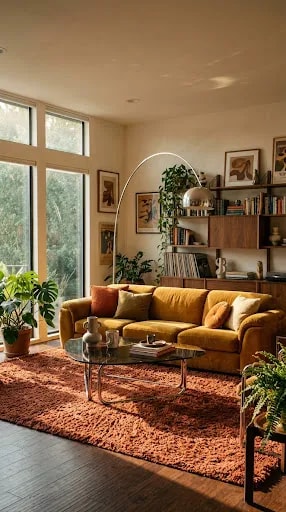
Look at the floor before you look at anything else. In this sunlit room the rust shag rug arrives first, a deep pool of texture that the mustard sofa, the chrome-and-glass coffee table, and the olive and cream cushions all seem to float on top of. That ordering is not accidental. It is the single most useful lesson the 1970s left behind: define the room from the ground up, then let the furniture gather around the definition.
The decade's famous conversation pits were really just a blunt instrument for a very good idea — a seating zone that feels like its own small world. You do not need to dig a hole in your floor to get it. An area rug large enough to sit entirely under the sofa and the table, with a couple of feet of breathing room beyond, does the same psychological work. Skip the wall-to-wall carpet that made so many 70s rooms feel sealed in. A rug with visible floor around its edges reads as intentional, contemporary, and much easier to live with when the seasons change.
What makes the arrangement feel current rather than costume is the vertical play. Low furniture pulls the eye down, which makes tall windows and high ceilings feel even more generous. The arc lamp is the counterweight, sweeping up and over the seating like a drawn line, echoing the window frames without competing with them. The glass tabletop matters too: chrome and glass let the rug's pile and color read straight through, so the center of the room never turns into a solid block. If you swap in a heavy wooden table, the rug becomes a border instead of a stage.
The palette is disciplined in a way that keeps nostalgia from tipping into pastiche. Three warm notes — mustard, rust, olive — plus cream, warm wood, and the green of a monstera and a few trailing plants. That is the whole recipe. The shelving on the right earns its place by mixing books, framed art, and objects at eye level, which softens the hard geometry of the windows opposite. Warm afternoon light does the rest, and it is worth arranging your day around it: sheer curtains, clean glass, and nothing tall in front of the brightest hour.
When you shop, go bigger on the rug than feels reasonable and lower on the seating than feels comfortable on paper. A pile of half an inch to an inch is enough to feel luxurious without swallowing chair legs. Keep patterns to one element, usually the rug, and let the cushions be plain in three tones. Then stop adding. The room in the photograph works because there is air in it, and air is the one thing no amount of vintage sourcing can fake.