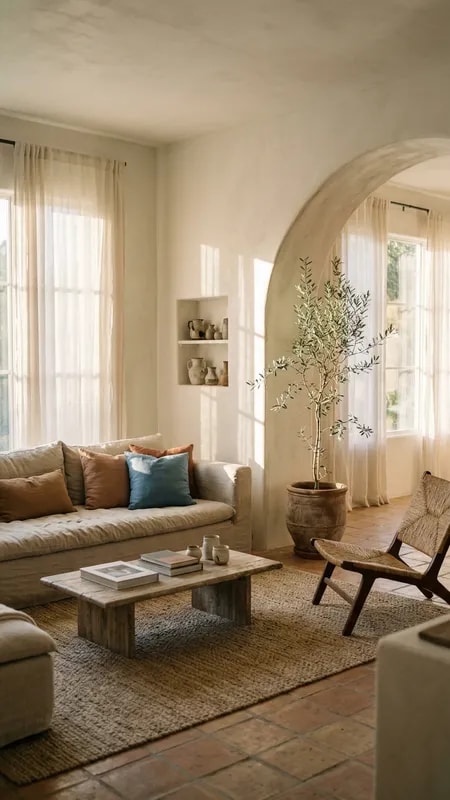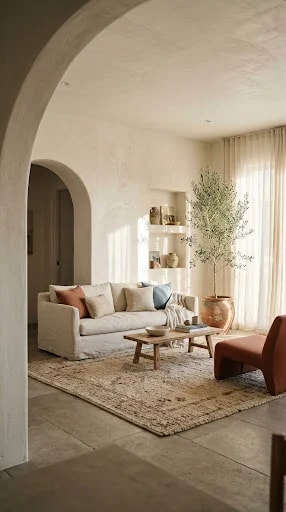
The first thing this room does is slow you down. You meet it through an arch, not a doorway, and that single curve changes the whole arrival. Instead of walking straight into a living room, you pass through a soft frame that trims the view down to what matters: an ivory sofa, a low wooden table, a wash of light across stone tile. Architects call it a vignette. At home, it just feels like the house taking a breath before inviting you in.
Inside the frame, the palette is deliberately narrow. Creamy whites hold the walls and upholstery, terracotta warms the floor and the rounded planter, and muted olive green arrives only where it grows — a potted olive tree standing in the corner light. Rust and soft blue cushions are the small disruptions that keep the scheme from going flat, echoing the clay and the sky in equal measure. Nothing in the room is glossy. Plaster, linen, wood, and aged wool all catch daylight the same way, gently, and the vintage rug underfoot adds the kind of texture that reads as history rather than decoration.
The architecture does most of the work. Recessed niches cut into the wall display neutral pottery without a single shelf bracket, so the collection feels carved into the house rather than added to it. Sheer white curtains diffuse the sun instead of blocking it, which is the difference between a room that feels bright and one that feels bleached. The floor, laid in pale stone, stays cool underfoot and bounces a soft glow upward onto the curved forms above. Every line is either upright or arcing — no hard corners competing for attention.
What makes it modern rather than merely rustic is the restraint. A traditional Mediterranean room might pile on pattern, ironwork, and color; this one edits. One tree, three cushion colors, a single wood tone, and an uncluttered coffee table are enough. The arch is repeated just often enough to feel intentional, then left alone. Storage disappears into the walls, lighting stays invisible, and the oldest pieces — the rug, the pottery — are given room to be the only things that look lived-in.
If you want to borrow the effect, start with the threshold. A curved opening, even a shallow one, gives any room a sense of occasion and gives your eye a place to land before it wanders. Keep the palette to three earthy anchors, let one plant carry the green, and choose finishes that look better chipped than polished. The goal isn't a villa in Greece. It's the calm that a well-framed patch of sunlight can give you, wherever you happen to live.