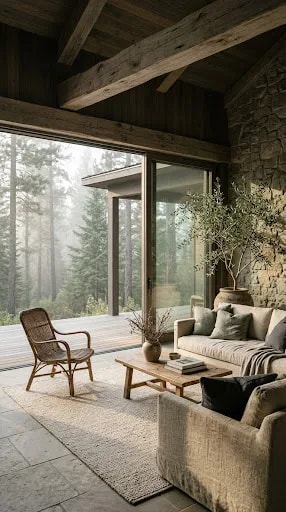
There is a moment in every retreat style home when the architecture stops and the landscape takes over. In this living room it happens at the glass: two vast doors slid fully open, their frames barely wider than a finger, so the stone floor appears to continue straight into the misty pine woods beyond. Nothing in the room competes with that view. The sofa sits low and pale, the coffee table holds dried stems and a small stack of books, and the eye is gently pushed outward again and again. The threshold, not the furniture plan, is the actual design decision here.
What makes the opening feel calm rather than merely dramatic is the material conversation around it. A rugged stone accent wall holds the interior side of the room, cool and mineral, while exposed wooden ceiling beams above warm it back up. Between those two poles sit the softer textures: a light beige linen sofa, olive green and charcoal pillows, a woven rattan chair, a potted olive tree leaning toward the light. The palette stays close to what is already outside — earthy browns, creamy neutrals, muted forest greens — so the room reads as an extension of the woods rather than a stage set placed in front of them.
Orientation does the rest of the work. The seating faces the glass, not a television, and the rug is laid to lead the eye forward rather than close the space off. If you are borrowing this idea, treat the frame as the most important element in the room: slim profiles, minimal mullions, and a track that lets the panels disappear entirely. Then let the flooring run to the edge without a distracting saddle or threshold strip. The illusion of continuity is what produces the exhale people feel when they walk in.
Light in a room like this is soft by nature. Diffused daylight filtered through fog and canopy arrives without harsh shadows, so the space can afford depth — dark stone underfoot, shadowed beams overhead — without turning gloomy. Layer for the cool mornings: a wool throw on the sofa, a textured rug that holds warmth underfoot, a candle or two on the table for the hours before the sun clears the ridge. Keep the surfaces quiet. Dried botanicals, a few well-chosen books, and one generous plant will do more than a shelf of objects.
The lesson is simple and easy to forget: a retreat style home is not decorated to impress from the inside. It is composed to frame what is already happening outside — the fog lifting, the pines moving, the light changing by the hour. Build the threshold first, choose materials that echo the land, and the room will feel like somewhere to stay for a very long time.