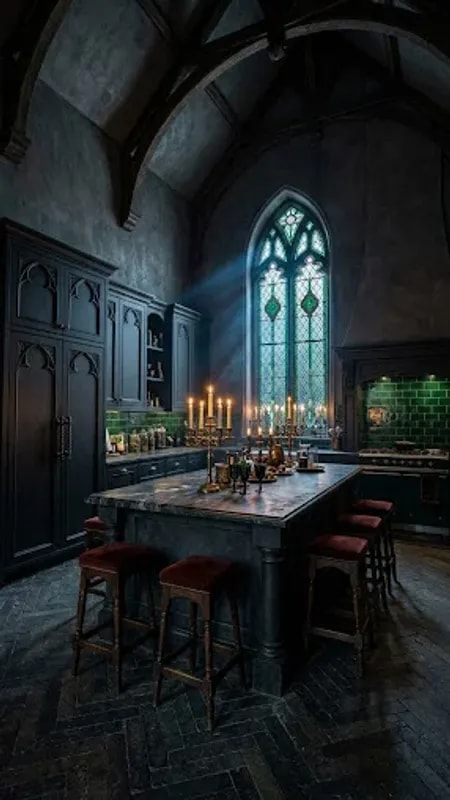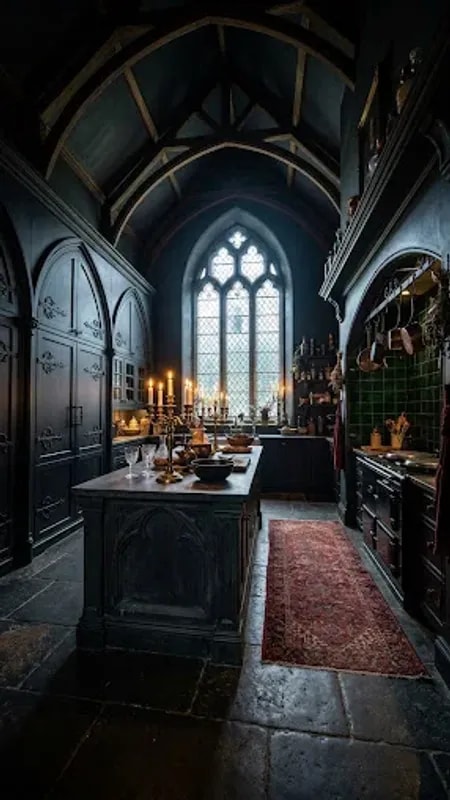
The first thing this kitchen does is pull you forward. A long island of dark stained wood runs straight down the center, its grain nearly black in the shadow, and every line of the room converges on the tall arched window at the far end. Ribbed wood vaulting overhead repeats those curves, so the ceiling feels less like a lid and more like the underside of a nave. Stained glass in the window throws cool silver-white daylight down the length of the floor, and somewhere near the island a few tapers are burning, adding a low amber counterpoint. It is theatrical, but it is also a working kitchen — and that balance is the whole trick.
Light is where a scheme like this lives or dies. Cold daylight through colored glass reads blue and a little severe, so the warm sources have to be deliberate: candles on the island, low sconces, maybe a pair of aged brass pendants kept on dimmers. Anything that floods the ceiling with flat white light will kill the drama instantly. The goal is pockets — bright at the window, glowing at the counter, softly dark in the corners — so the eye travels the room instead of scanning it. If you are rebuilding, put your task lighting under the upper cabinets where it lights the cutting board and not the backsplash field.
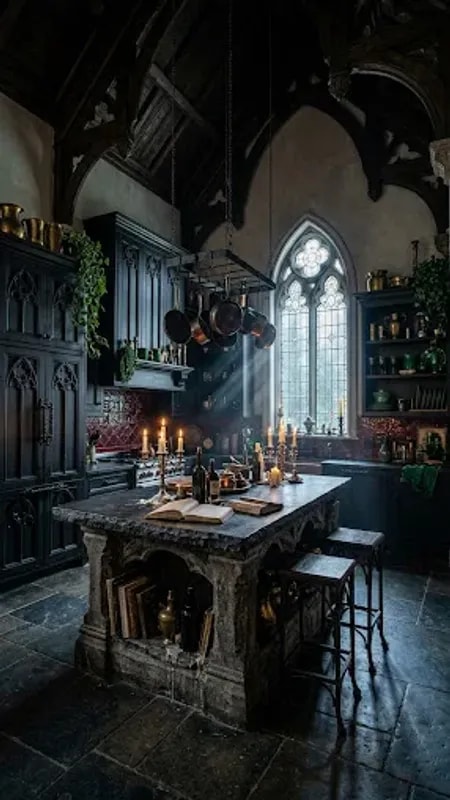
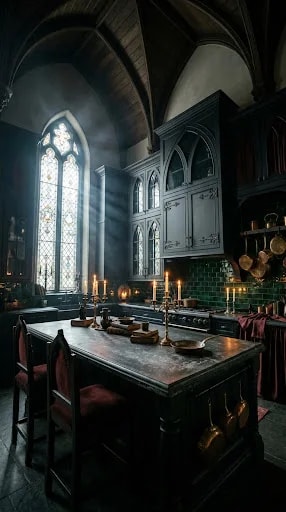
The palette is tight and worth stealing exactly as it appears: charcoal cabinetry, forest-green tile, copper, and a single hit of crimson. The green backsplash is the quiet hero, laid in a glossy tile that picks up the window light and keeps the dark cabinets from going flat. Copper pots hung in a row echo the candle glow and add a metal that ages instead of dating. The red-upholstered chairs at the island are the only saturated note in the room, which is why they work — one vivid accent against black and green reads as confidence, not clutter.
Cabinetry in this style tends to borrow church vocabulary: pointed-arch mullions, slim vertical stiles, dark frames around glass. Keep the ornament shallow and the frames simple, or the doors start to look like stage scenery. Function still rules. Deep drawers beside the range, a clear path around the island, and a work zone that does not require walking into shadow matter more than any arch. Rustic tableware, a wooden board, a jug of branches — the styling here is deliberately sparse, and that restraint is what makes the room feel inhabited rather than decorated.
What makes it work as a home rather than a set is warmth at the human level: a chair you want to sit in, light at eye height, materials that feel good under the hand. Gothic is often treated as a costume. Here it is a mood you can cook dinner in.