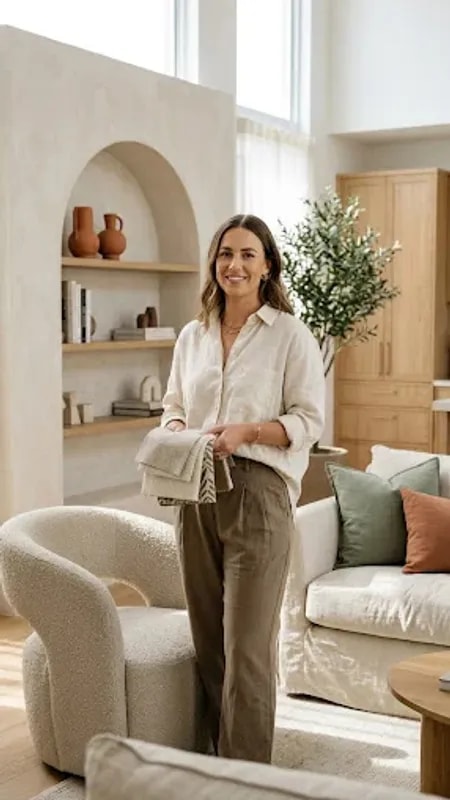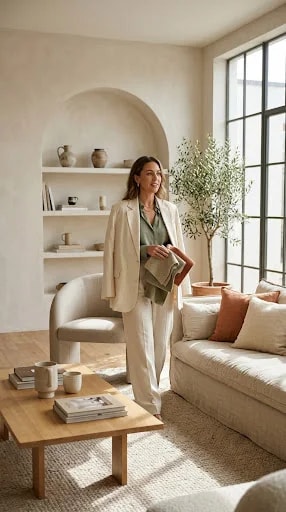
A room like this one rarely announces itself with a single label. Cream walls, an arched niche lined with ceramics, a curved armchair, an olive tree set against a black grid window — the pieces read as calm rather than as a manifesto. Yet the names matter, because a name is how you find the next sofa, the right paint, the rug that finally makes the floor feel finished. Home design style names are simply shorthand for a cluster of decisions about color, shape, texture, and light. Learn to read them and a photograph like this becomes a set of instructions.
The closest match here is organic modern. It keeps minimalism's restraint but softens every hard edge: curved upholstery, plastered or limewashed walls, arches cut into thick masonry, matte finishes that absorb light instead of bouncing it. The palette is where this style earns its name — cream, sand, bone, and warm wood lifted by olive green and terracotta, the exact combination in the cushions and the folded layer in the woman's arms. Plants act as architecture rather than decoration, and pottery with visible hands on it is treated as sculpture. If a room feels airy but never cold, organic modern is usually the correct label.
Warm minimalism is a sibling, not a twin. Both edit hard, but warm minimalism works in fewer materials and relies on texture — bouclé, raw linen, unlacquered brass — to carry the visual weight. Scandinavian design shares the light wood and pale walls, though it leans cooler and more practical, with a stronger furniture pedigree. Japandi goes quieter still, pairing Japanese asymmetry and wabi-sabi imperfection with Scandinavian function; you would expect lower seating, darker accents, and less ornament. Transitional is the diplomat of the family, blending traditional silhouettes with contemporary finishes, and it suits rooms with original moldings or a formal fireplace that refuse to disappear. Quiet luxury overlaps all of them, describing budget and finish more than form.
Naming your own style is easier than it sounds. Choose three anchor words first — calm, earthy, architectural — and test every purchase against them. Then fix a palette of five colors and let nothing else in: here it would be cream, sand, warm oak, olive, and terracotta. Finally, pick one shape language and repeat it, since the repeated curve of the armchair, the arch, and the round table is what makes this room feel composed rather than assembled. The names do the searching; the anchors do the deciding. Once both are in place, a room stops looking like a showroom and starts looking like someone lives there.