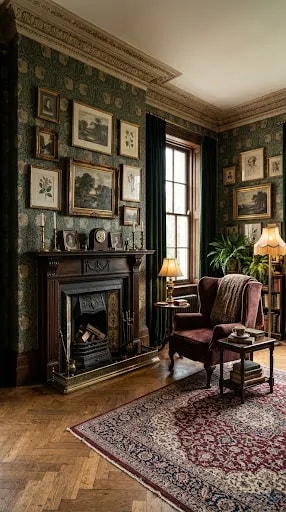
British sitting rooms rarely arrive in one shopping trip. They read as accumulations — a chair inherited, a rug that predates the sofa, a print bought on a wet afternoon and framed years later. The corner shown here makes that logic visible from the floorboards up. Parquet underfoot, a Persian-style rug laid over it at an angle, a floral green wallpaper climbing the wall behind the mantel, and heavy curtains dropping the full height of a tall sash window. Each layer answers the one beneath it, which is why the room feels settled rather than staged.
The palette does the quiet work. Deep green wallpaper with a small repeating floral gives the wall texture without demanding attention, so the eye travels to the burgundy wingback and the throw folded over its arm. Brown wood on the fireplace and side tables, brass on the candlesticks and lamp bases, cream on the lampshades and ceiling — five colours, repeated at intervals so nothing feels stranded. Dark walls beside a window are often feared, but here the green absorbs the daylight and hands it back warmer, which is why the room reads intimate at four in the afternoon and close to glowing at dusk.
The gallery wall is deliberately uneven. Landscapes and botanical studies sit in mismatched frames, hung close enough to feel like one collection rather than scattered orphans, filling the space between the curtain edge and the fireplace breast. Below them, the mantel carries a clock and a pair of candlesticks — nothing more. That restraint matters. When the wall is busy, the horizontal surfaces stay calm, and the room avoids the cluttered look that layered interiors slide into.
Light is the real structure. A tall window supplies a cool, directional wash from the centre of the composition, while table and floor lamps throw low amber pools into the corners the daylight never reaches. Nothing is lit from above. The result is a room that seems to dim at the edges, pulling the wingback, the stacked books, and the potted plant into a pocket of warmth. Heavy curtains frame rather than block, drawn back far enough to keep the window as a bright vertical stroke in an otherwise dark composition.
If you want to borrow the effect, start with one anchor — a fireplace, a chair, a rug — and build outward, adding height last. Mix wood tones instead of matching them, let a rug sit slightly off-square, and leave one wall or shelf deliberately empty. Buy lamps before you buy art, and place them where you actually sit. The charm of a British room is that it looks like it happened gradually, even when it was planned.