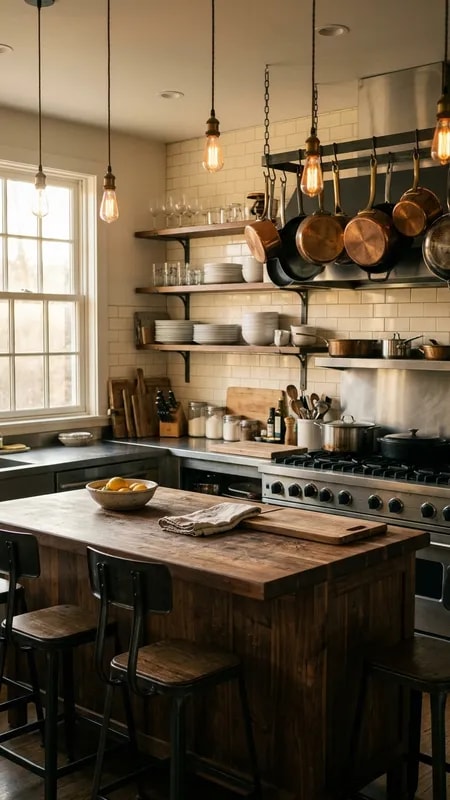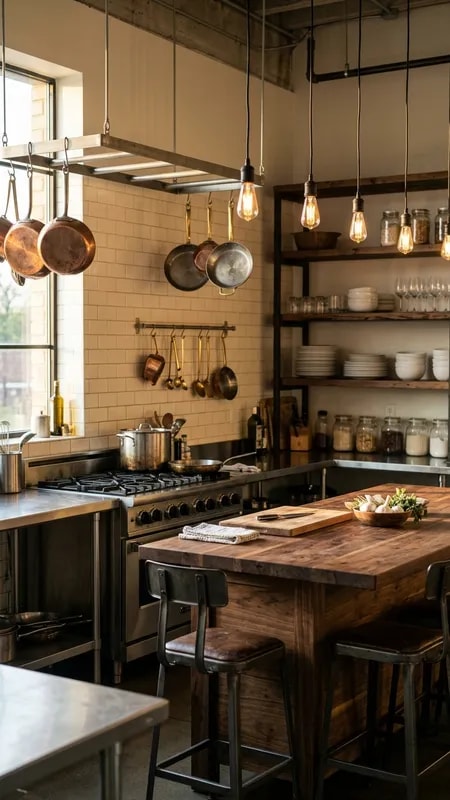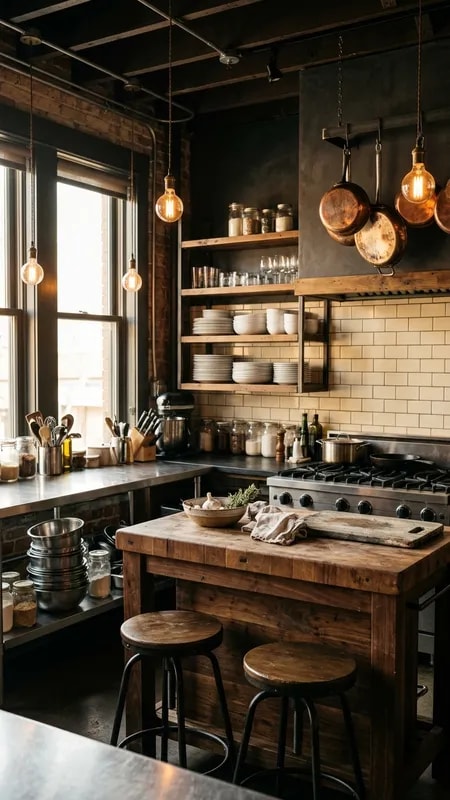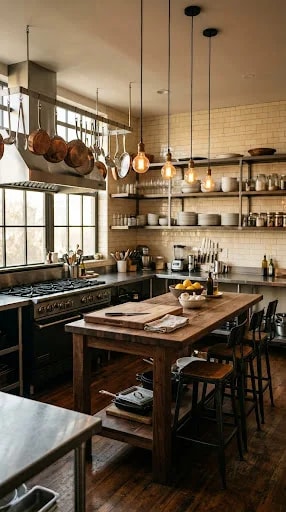
Walk into the best neighborhood restaurants and you rarely find a kitchen that looks staged. You find stacks of white plates within arm's reach, a rail of copper pans darkened at the handles, a cutting board that never quite gets put away. That is the mood this kitchen borrows, and it explains why the walls are lined with open shelves instead of closed cabinetry.
Open shelving is the single most consequential decision in a restaurant-style home kitchen, because it changes how you behave in the room. When your dishes and jars are visible, you stop stockpiling and start curating: a run of white plates, a few glass jars of grains and pasta, a bowl that only comes out for guests. The shelves here climb beside a wide window, so the ceramics catch daylight through the afternoon while pendant bulbs pick up the slack after dark. Nothing matches perfectly, and that is precisely why it reads as collected rather than purchased in one afternoon.
The same logic governs the hardware. Stainless counters take a beating and improve for it, developing the faint scuffs and patina that make a professional pass look honest rather than precious. A stainless range below a hanging rack of copper pots keeps the working triangle tight and puts the tools on display, which is its own kind of decoration. Subway tile behind the range handles splatter without fuss, and the brushed metal reflects the amber glow of the pendants so the room feels lit from every direction at once.
The island does the rest. In a vertical frame like this one, the rustic wood block sits in the foreground, absorbing the room's honeyed light and anchoring the palette of cream, charcoal, copper and steel. Dark metal stools tuck underneath without crowding it. A cutting board, a bowl of lemons, a knife left out — these are the small, useful still lifes that signal a kitchen where someone actually cooks. Restaurants leave their mise en place visible because it makes the next task faster; at home, the same habit makes the room feel inhabited rather than abandoned.
If you want to imitate this, resist the urge to fill every surface. Keep one shelf sparse, let the copper hang unevenly, choose a wood island with visible grain and a few knots, and put the everyday plates where your hand naturally falls. Restaurant style at home is less about buying the right pieces than about arranging them as though dinner is twenty minutes away.