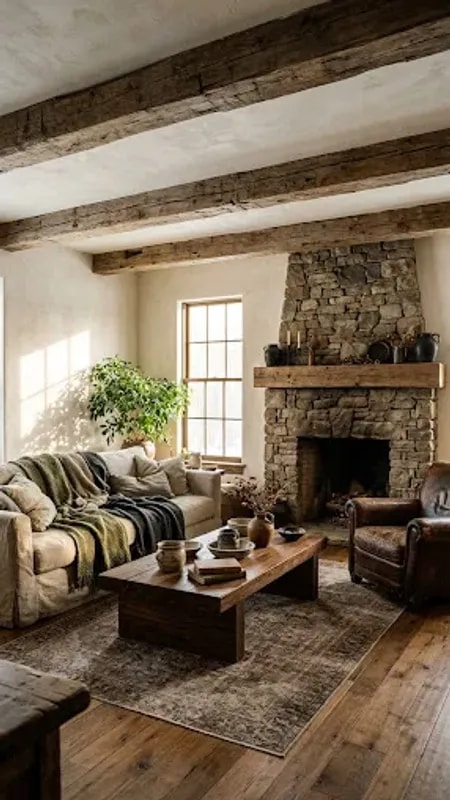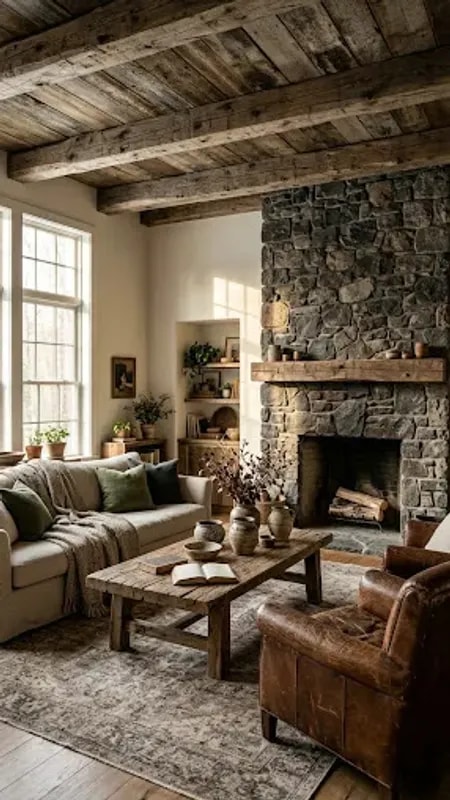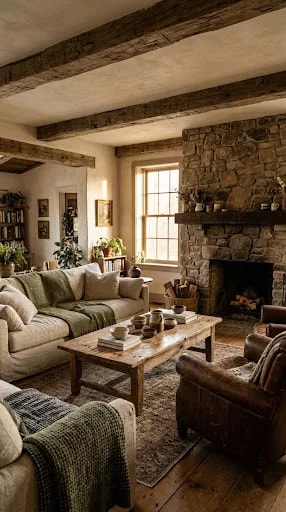
Some rooms are styled; this one is inhabited. The fieldstone fireplace rises almost to the ceiling, its stones irregular and mortar-thick, and everything else in the room arranges itself around that anchor. A cream sofa sits low and generous on the left, an olive throw crumpled where someone left it, a leather armchair angled toward the hearth. The wide view takes in the beams overhead, the wood floor underfoot, the window light falling soft and unforced across the rug. Nothing here looks arranged for a photograph, which is exactly why it photographs so well.
The architecture does the heavy lifting. Exposed timber beams and honey-toned wood floors give the room its warm skeleton, while the stone wall supplies weight and a cool gray counterpoint. That pairing — rough masonry against smooth milled wood — is the backbone of rustic style, and it works because the materials are allowed to stay a little imperfect. Knots show. Stone edges chip. The beams are not pretending to be steel. When the daylight comes in from the window, it rakes across those textures and makes the whole room read as depth rather than decoration.
Comfort, though, comes from the layers. The palette stays close to cream, beige, and leather brown, then lets muted green do the talking: olive pillows, a throw folded over the sofa arm, a patterned rug that quietly picks up the stone grays. Textiles soften what would otherwise be a hard room — a leather chair, a chunky wooden coffee table, a floor that echoes. A basket of firewood beside the hearth adds one more organic texture and, more practically, means the fire actually gets lit.
Look closely and the accessories are useful things: books stacked on the coffee table, ceramic bowls, a shelf of volumes behind the sofa, potted plants that need watering, framed art hung where there was wall. That is the quiet rule of a lived-in rustic room — objects earn their place by being handled. A bowl you use for snacks, a basket that carries wood, a blanket that gets pulled over knees on a cold evening. Rustic design fails when it becomes a display of old things; it succeeds when the old things are still working.
To build a room like this, start with the immovable elements: the stone, the timber, the floor. Spend there and let it settle. Then layer slowly — one good sofa in a light neutral, a leather chair with some age on it, a rug with enough pattern to hide footprints, throws in a muted green or rust. Buy the coffee table heavy enough that nobody moves it by accident. And leave the blanket where it fell. The warmth in this room is not a lighting trick; it is the accumulated evidence of evenings spent in it.