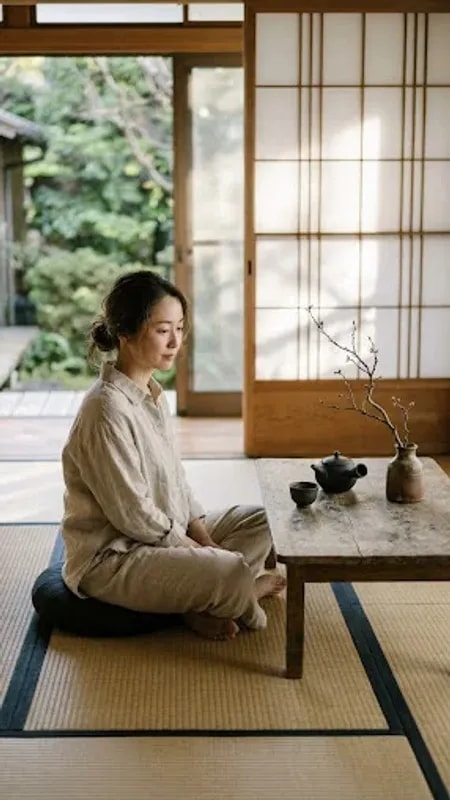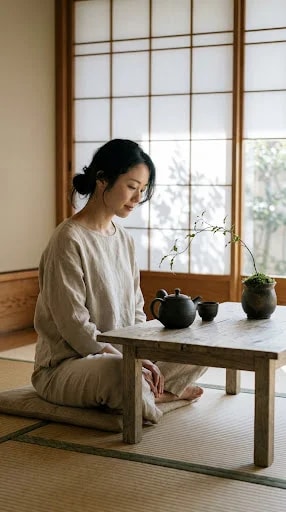
There is a particular kind of stillness that arrives the moment you sit down on the floor. In the scene above, a woman in loose natural linen settles onto a cushion beside a low wooden table, a dark ceramic teapot and a single cup within reach. Behind her, a shoji screen repeats its grid of pale squares, and beneath her, tatami mats run their green borders in quiet parallel lines. Nothing in the frame is expensive-looking. Everything in it is deliberate.
The most consequential choice in a Japanese-style room is often the one nobody names: the height of the furniture. Dropping the table to roughly thirty centimeters does something remarkable to a space. The ceiling appears taller, the walls seem to recede, and the room stops feeling like a container for objects and starts feeling like a volume you inhabit. Chairs disappear, and with them the rigid arrangement of seat, back, and armrest that dictates where a body goes. A cushion asks less of you. It lets a corner of a small room hold two people, a pot of tea, and nothing else.
Materials carry the rest of the work. Tatami is the anchor, and its green or black cloth border draws long horizontals that make a narrow room feel wider. Where tatami is impractical, the same logic holds in seagrass, worn oak, or a flat-weave wool rug in oatmeal. Wood should read as wood: matte, unlacquered, with a visible grain and a soft edge where a hand might rest. Ceramics should be dark and slightly uneven, the kind of teapot that looks better after a decade of use. Linen and cotton in undyed tones absorb light rather than bounce it, which is why a room built from beige, charcoal, and warm brown never reads as bland.
Light is the quietest material of all. A shoji screen is essentially a diffuser, a sheet of paper stretched over a lattice that turns direct sun into an even, shadowless glow. You can borrow the effect without the joinery by hanging a linen roman shade, fitting rice-paper pendants, or placing a floor lamp behind a folding screen so the bulb is never visible. The goal is light with no visible source, the same softness you get on an overcast morning, when a room seems lit from within rather than lit from a window.
Adopting the look rarely requires a renovation. Start with one low table and two floor cushions, placed where a sofa used to be, and see how the room changes around them. Keep surfaces nearly empty: one vase, one branch, one cup. Let the screen or the shade do the decorating, and resist the urge to fill the space that the lower horizon opens up. The generosity of this approach is that it gives back emptiness, and emptiness, in a small home, is the rarest luxury there is.