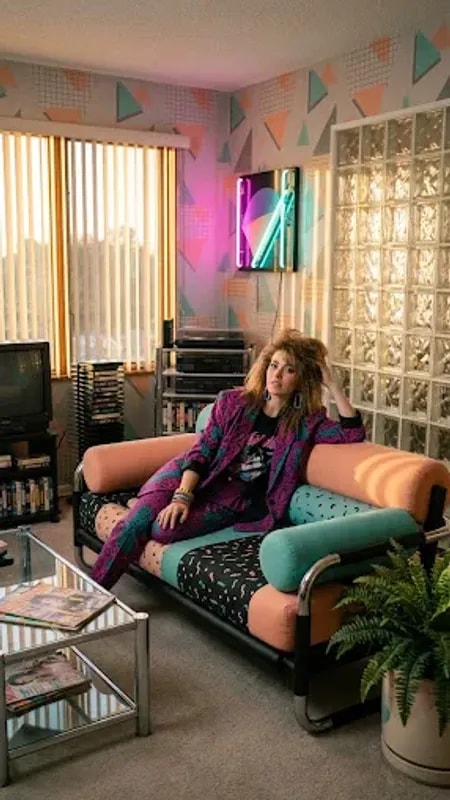
The first thing that hits you is the hair, then the sofa, then everything else in the room at once. That is not an accident. The 1980s never met a surface it did not want to cover, and this scene — a towering teased silhouette against a sculptural sofa, glass block glowing behind her, magenta neon spilling from the left — is maximalism with perfect posture. If the recent revival has mostly tiptoed through tasteful nods, this is the version that walks in, turns the music up and rearranges the furniture.
Start with color, because in an 80s room the palette does the heavy lifting before a single piece of furniture arrives. Mint green and peach handle the soft work, warm and slightly chalky rather than candy-bright. Hot pink is the exclamation point, delivered through neon, a cushion or a lacquered side table. Then break the sweetness. Pastels alone turn sugary fast; the black-and-white geometric rug, the leopard-print throw or a black lacquer frame is what gives the scheme its snap. The trick is that the pattern does not match anything — it argues with everything, politely.
Texture is where the decade gets specific. A glass block wall filters daylight into something cinematic and gives a narrow room a glow without a window. Chrome frames throw light back across the floor, and a glass-topped coffee table keeps the center of the room visually light even when the seating is deep and generous. Add lacquer, Lucite, a little brushed brass, and one deeply impractical velvet. Then let the props do the storytelling: a chunky telephone, a fan of vintage magazines, a stack of art books that look read rather than bought. Styled clutter is the engine of this look — arranged, but not precious.
Neon is the element most people want and few know how to handle. Keep it small and legible, in script rather than block letters, and treat it as jewelry for the wall rather than a light source. Modern LED neon runs cool, installs easily and can sit on a dimmer, which matters when the sign shares a room with a television. One sign per room, mounted where it can throw a colored wash across a pale surface, is enough. Two turns the whole thing into a theme bar.
Plants earn their square footage here. Ferns and palms fill the vertical gaps that patterned wallpaper would otherwise claim, and their softness offsets all that glass and chrome. Go for a few large architectural specimens instead of many small pots; scale is the whole argument. The one rule that keeps maximalism wearable is editing by hierarchy — pick four heroes, the sofa, the wall, the light, the plant, and let everything else play supporting roles at half the volume. Get that balance right and the room reads as confident rather than chaotic, a time capsule you actually want to sit in.