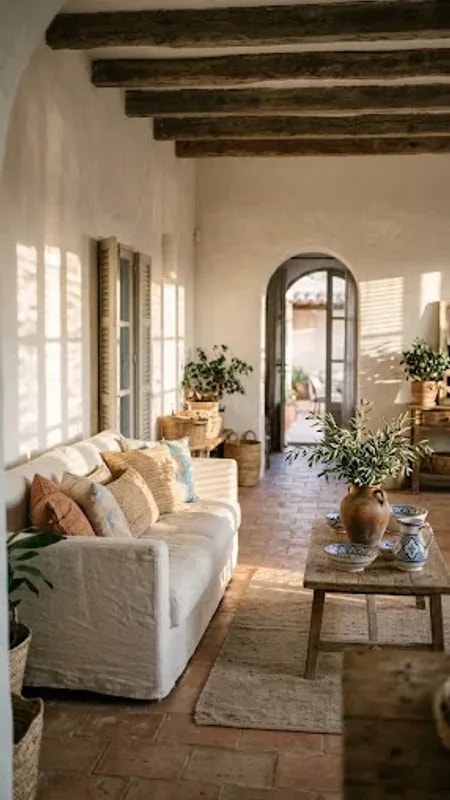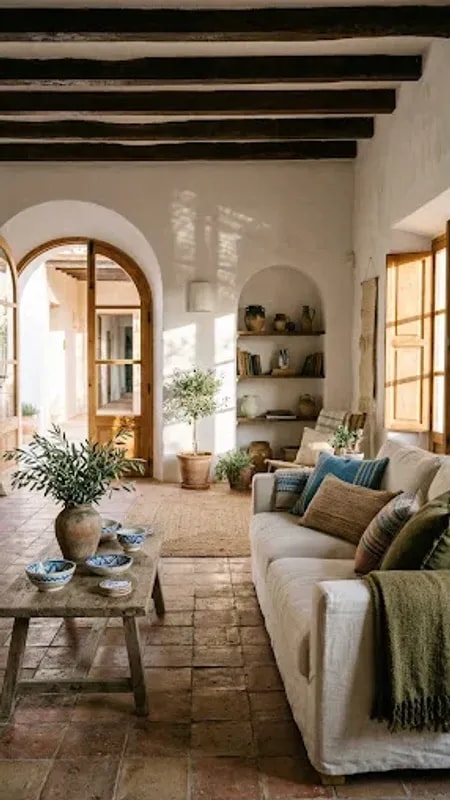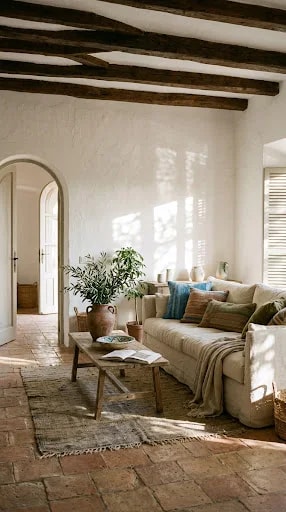
The most convincing Mediterranean living rooms never look decorated. They look like someone opened the shutters one morning, set down a basket of olives, and let the room settle into itself. That impression comes from restraint rather than abundance. In this space, a single generous sectional anchors everything, and the rest of the furniture is kept low, sparse, and slightly off-center so the eye can travel across the room without hitting a wall of objects. The result is a living room that reads as spacious even when it isn't, and as calm even when it's full of life.
The palette does most of the quiet work. Walls washed in soft lime or chalk paint hold a creamy, uneven tone that shifts with the light, and the upholstery follows close behind in oatmeal linen. Browns come in through a chunky wooden coffee table and darker floorboards, while greenery arrives only through olive branches in terracotta pots. Notice how little color there is: one muted blue throw pillow, and that's nearly it. That single accent works precisely because nothing competes with it. If you want this look, pick one cool accent, keep it to a cushion or a ceramic vessel, and let the earth tones carry the room.
Texture is where Mediterranean interiors earn their warmth. Woven baskets sit beside the sofa holding throws or firewood, a jute or flatweave rug softens the hard floor, and ceramic table lamps with simple linen shades add a hand-thrown irregularity that factory-made pieces can't fake. Slipcovers matter too, especially in washed linen or heavy cotton that creases and softens with use. The rule of thumb is texture over pattern: skip the busy tile-print cushions and pile on materials you want to touch, because the scheme is built on how things feel in the hand and underfoot.
Arrange seating for conversation, not for symmetry. A deep sectional pushed against one wall, a pair of woven or rush-seat chairs opposite, and a low table within easy reach of every seat will always beat a matching suite. Leave real gaps between pieces. Mediterranean rooms breathe through their empty floor space, and that negative area is what makes the whole composition feel unhurried and easy to walk through.
Finally, treat daylight as a material. Keep windows as bare as privacy allows, or use linen sheers and painted shutters that filter sun into long, soft shadows across the plaster. Layer lamps at seated eye level so the room glows after sunset, group plants where the light actually falls, and resist the urge to fill every surface. The charm of this style lives in its imperfections: a slightly crooked pot, a worn wooden edge, a sofa with a visible dent in the cushion where someone always sits.