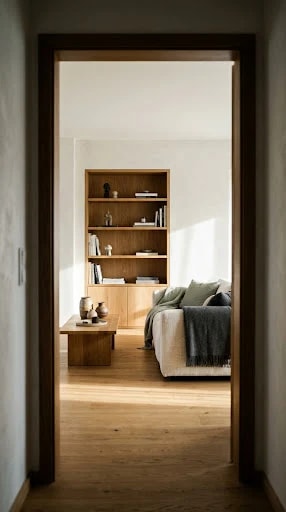
Stand in the hallway and the room arranges itself for you. The heavy dark wood of the doorframe crops the view to a single, generous rectangle: honey-oak shelving running wall to wall, a pale sofa with a charcoal throw folded over one arm, sage-green pillows, a low table holding two vases and nothing else. Sunlight enters from the right and lands on the white back wall in hard-edged shapes, the shadow of the window mullion drawn across the plaster like a pencil line. The floor is wide-plank oak, pale enough to bounce light back up into the room.
The organising idea here is joinery. In German style home interior design, the built-in is not a luxury upgrade but the default assumption — a wall of shelving or an Einbauschrank measured to the millimetre, fitted between skirting and ceiling so that no gap interrupts the line. That single decision does an enormous amount of work. It absorbs the books, the ceramics, the paperwork and the odd-shaped objects that would otherwise scatter across tables, and it gives the room a spine. Everything else can then afford to be sparse, because storage is no longer a problem to be solved in the open.
Notice how little colour there is, and how deliberately the few tones are placed. White on the back wall is not austerity for its own sake; it is a reflector, chosen so that the moving geometry of sunlight becomes the decoration. The oak brings warmth at floor level and again in the shelving, so the wood grain ties the two planes together. Then two accents, sage and charcoal, both muted, both repeated — the pillows pick up the green of a glazed vessel on the shelf, the throw echoes the dark doorway you are standing in.
The shelf itself is curated rather than filled. Books stand upright in short runs, with breathing space between them; ceramics sit alone or in pairs; a horizontal stack breaks the vertical rhythm. This is the part that takes patience and the part most often skipped. A built-in crammed to its limits reads as storage, while one edited to two-thirds capacity reads as architecture.
The lesson worth borrowing is structural, not decorative. Measure the longest uninterrupted wall in your living room and give it over to fitted shelving in a warm, honest timber. Keep the surrounding walls a flat, light colour so the light has something to do. Limit textiles and objects to two muted accents, repeated at least twice. And leave the doorway open — a room composed to be seen through a frame will always feel calmer than one that announces itself all at once.