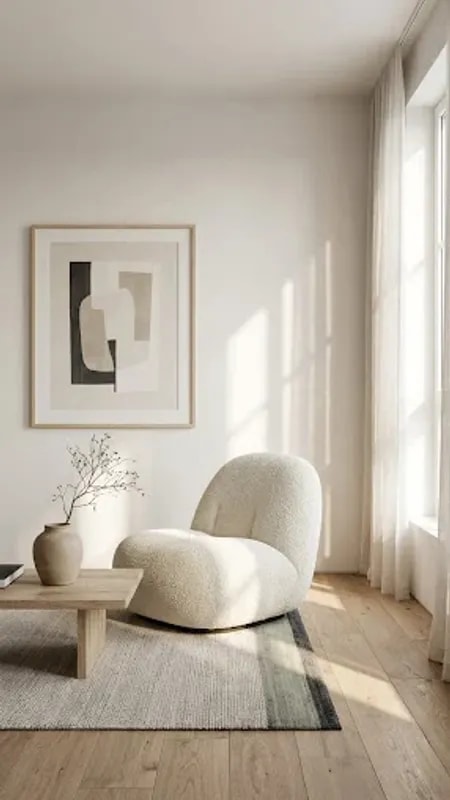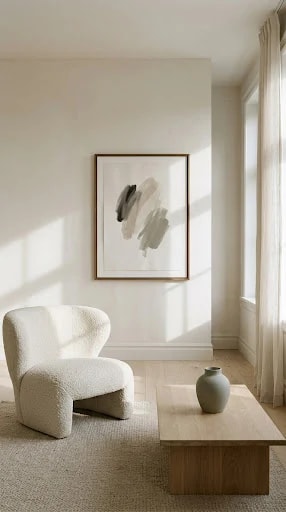
There is a corner in this room that does almost nothing, and that is precisely its achievement. A curved bouclé armchair sits low and soft against a plaster wall, turned slightly toward the light. Beside it, a pale oak coffee table holds one muted sage vase and nothing else. Above, a large abstract canvas in a thin wood frame floats without competing with anything around it. The whole arrangement takes up perhaps a third of the available floor, leaving the rest open, and it is that open half which makes the corner feel finished rather than sparse.
Most rooms are overfurnished out of anxiety, not need. We fill the empty wall, then the empty floor, then the surface, until every sightline ends in an object. Minimalism works the other way: it treats empty space as a material with its own weight. Here the left side of the composition is essentially blank, a stretch of wall and floor that lets the eye rest before moving to the chair. That imbalance is intentional. Symmetry would have made the scene tidy; asymmetry makes it breathe.
Color does the quiet labor. Creamy white, warm beige, and soft blonde wood form a narrow band of tones that never fight for attention, while the sage vase provides the single note of color the room allows itself. This is the discipline worth copying: choose a neutral base, then introduce exactly one accent, in exactly one place. Two accents and the eye starts negotiating. The same logic applies to shape. The chair's curve is the only organic gesture in an otherwise rectilinear space, which is why it reads as sculpture rather than as seating. A room of straight lines needs one soft thing to feel human.
Light is the decoration that costs nothing. Sheer white curtains diffuse the sun instead of blocking it, so daylight arrives as a wash rather than a beam, and the diagonal shadows it throws across the plaster become the most interesting pattern in the room. Texture matters as much as tone here. Bouclé, raw plaster, matte ceramic, and unstained oak all absorb light instead of reflecting it, giving a neutral palette depth that a glossy finish would flatten immediately.
If you want this feeling at home, start by removing two things before you add one. Push the furniture away from the walls and let a gap open up. Hang a single large piece rather than a cluster of small ones, keep your tabletop to one object, and hang curtains high and wide so light stays soft. The goal is not emptiness for its own sake, but a room calm enough that sitting still in it feels like the point.