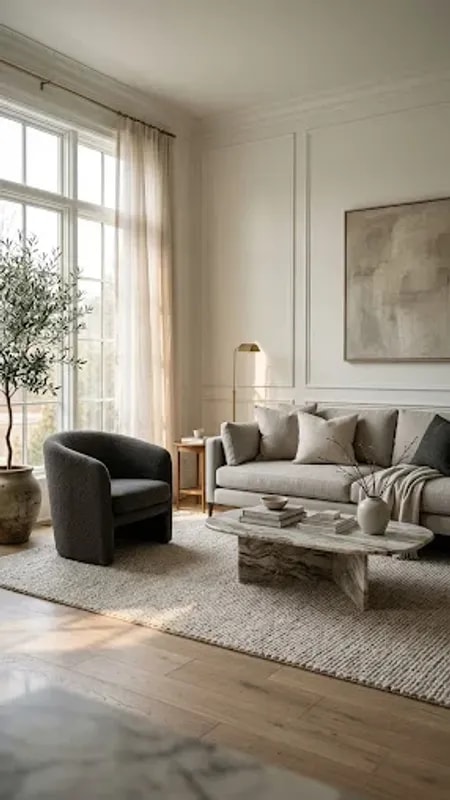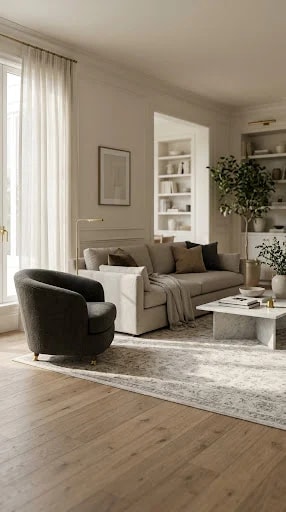
At first glance this living room reads as calm, almost monochrome — cream sofa, pale oak floors, white built-ins, a wash of daylight through sheer curtains. Look a beat longer and the room reveals its real strategy. A single charcoal armchair, curved and dark, sits beside the sofa like a full stop at the end of a long, quiet sentence. That is transitional design at its most useful: not a beige blur, but a carefully paced mix of old and new, soft and strong, where every contrast has a job.
The chair earns its weight because nothing else competes with it. The sofa stays light, the throw stays textured rather than colorful, and the marble coffee table holds the middle ground with cool grey veining that echoes the darker chair without shouting. When you are layering a neutral room, this is the ratio worth borrowing — roughly nine parts soft to one part bold. Add a second dark element and the balance tips into heaviness; remove this one and the whole space goes flat.
Texture does the quieter work. A nubby throw over the sofa back, a low-contrast patterned rug over light oak, the matte sweep of the curved chair against polished stone — each surface changes how the light lands, which is what keeps an earthy palette from feeling like a paint chip. Sheer curtains on the left filter the sun into a diffused glow, softening edges and letting the shadows do the decorating.
The architecture carries traditional bones: built-in white bookshelves with simple trim, a symmetrical feel, generous ceiling height. The furniture answers with modern restraint — no skirted sofas, no heavy carving, just clean silhouettes with rounded corners that feel friendly rather than sharp. A tall green plant in the corner adds the only saturated color in the room, and it is enough. Notice, too, how much space is left empty. Negative space is a material in transitional rooms; it is what lets the eye rest between objects.
If you want this feeling at home, start with a light, warm base on floors and walls, choose upholstery in creams and soft greys, then pick one piece — a chair, a lamp, a cabinet — in deep charcoal or walnut to anchor the composition. Keep the metal and stone finishes quiet, layer two or three textures you can actually touch, and leave the corners a little emptier than feels comfortable. The result is a room that looks inherited rather than decorated, and calm enough to actually live in.