Most courtyards are remembered not as a whole but as a single corner. That is where the eye settles after crossing the paving, where shade deepens, and where the house finally speaks. In the traditional Mediterranean model, corners were never leftover space; they were the destination, the spot where a chair was pulled into the afternoon shadow and a jar of water stayed cool. Designing one well is less about filling it than about deciding what deserves to be looked at.
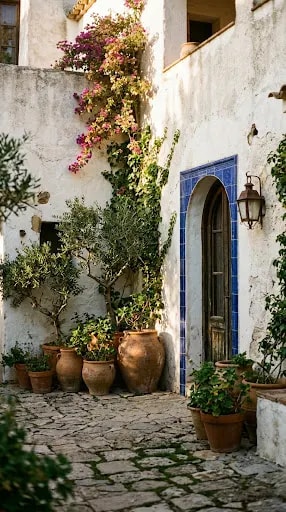
The wall comes first, because everything else is judged against it. Limewashed stucco in chalky white or warm cream gives the sun something to model, and a hand-troweled surface keeps its texture even at midday, when flat paint would go dead. The arched door is the anchor: a single vertical gesture that gives the corner its scale. Around it, glossy cobalt tile works like jewelry, and it works best in short, deliberate runs — a band framing the arch, a skirt at the base — rather than spread across the whole facade. One saturated blue against all that white is enough; two competing colors turn a quiet corner into a showroom.
Containers do the rest of the composing. Terracotta reads as architecture here, not as a plant accessory, and grouping pots in odd numbers at three distinct heights keeps the arrangement from looking catalogued. A tall amphora-shaped jar breaks the horizontals, a low bowl of trailing greenery softens the base of the wall, and a single olive in a broad pot supplies the silver-green canopy. Then there is the bougainvillea: one cascade, not three, allowed to spill over the arch and stain the stucco with magenta. Restraint is what makes the abundance feel natural.
Underfoot, stone paving with moss in the joints carries the corner into the ground instead of letting it float. Run a narrow path of cobbles toward the door so the eye has a lead-in, and let the edges stay slightly soft, with thyme or mind-your-own-business creeping between stones. Above, an iron lantern on a bracket, a sliver of balcony, a shutter left ajar — these small vertical interruptions keep the composition from becoming a flat backdrop.
Come evening, the same corner changes registers. The lantern throws a warm pool of light upward across the stucco, the blue tile goes nearly black, and the bougainvillea disappears into silhouette. That is the test of a well-made vignette: it holds up in raking afternoon light and again in the dark, when all that remains is an arch, a glow, and the smell of warm stone.