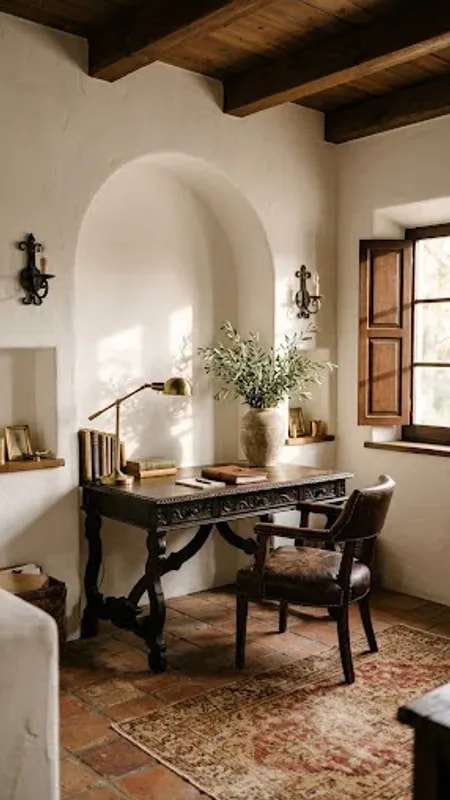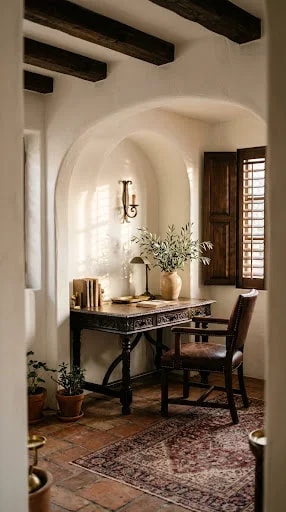
A niche barely wider than a desk should feel like a compromise. Here it reads as a destination. The arch does the work of a doorway without a door, and because the opening frames the desk so precisely, the eye treats the whole white-plastered recess as a room within a room. Everything behind that curve belongs to the same quiet world: the carved wood, the leather, the brass, the olive branches leaning out of a vase. Step past the wall edge and you have left the rest of the house behind.
The depth is built in layers rather than square footage. First the red clay floor tiles, worn and slightly uneven, running straight into the alcove. Then the patterned rug, laid just inside the threshold to soften the transition from tile to chair. The desk sits forward of the back wall so the plaster behind it stays visible, catching light and giving the niche a few extra inches of atmosphere. Terracotta pots flank the opening at floor level, and the silhouette of louvered shutters shows at the side, half-open. Nothing crowds; every object has air around it.
Light is the real material here. Sun through the shutters lands in soft horizontal bands, striping the plaster, the desk edge, and the pages of the stacked books. It moves through the day, so the alcove is never quite the same twice: bright and almost chalky at midday, honeyed in late afternoon. A small brass lamp waits on the desk for the hours when the sun has moved on, and a wall sconce picks up where the lamp leaves off. The lighting plan is really just an argument for keeping the shutters instead of replacing them with something more efficient.
The palette is deliberately narrow, which is what keeps a small space from turning busy. Warm white on the plaster, honey brown in the wood, terracotta underfoot, olive green from the branches, and near-black in the deepest grain of the desk and the ceiling beams overhead. Five colors, repeated rather than added to. Because the tones echo each other, the alcove feels larger than its measurements suggest, and the transitions between floor, wall, and furniture read as one continuous surface.
What you end up with is a desk you actually want to sit at. The leather chair faces a wall instead of a window, so there is nothing to stare at but plaster, branches, and the pattern of light sliding across them. For slow, focused work, that is not a limitation. It is the entire point.