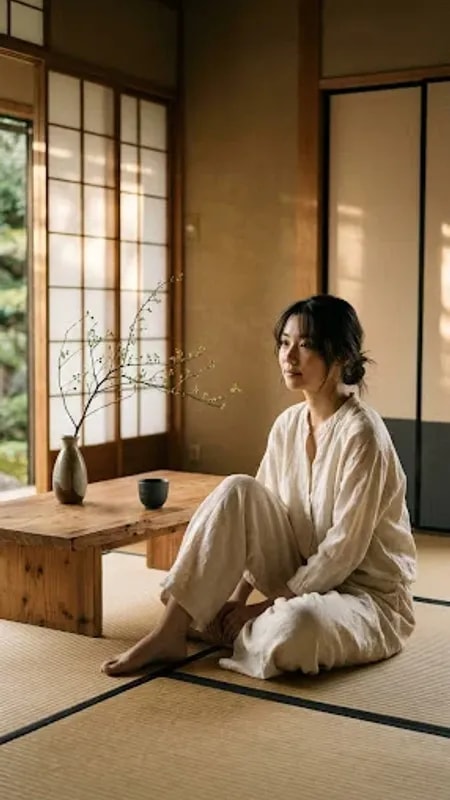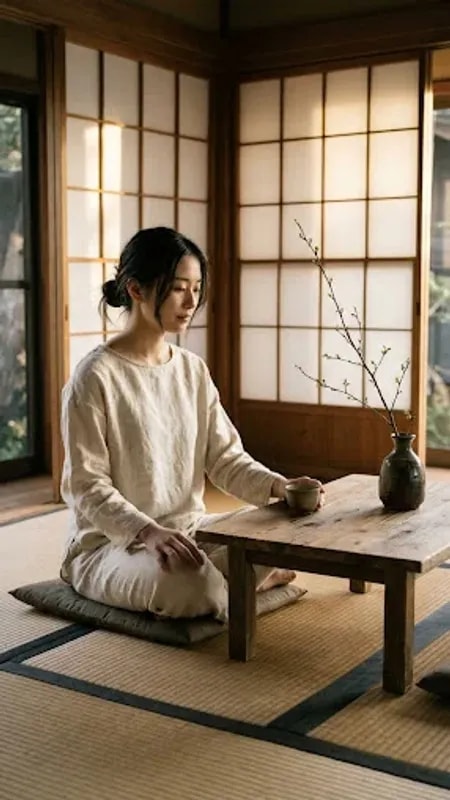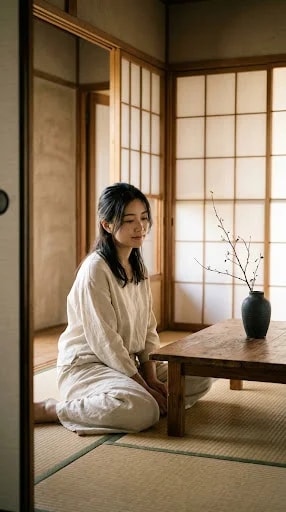
Stand in the corridor and look through a half-open shoji and the room arranges itself for you. The doorway crops the scene: a woven tatami floor with its dark green border running like a drawn line, a low table on the right, a woman kneeling on the left, and a dark ceramic vase holding one bare branch that leans exactly as far as it needs to. Nothing in the frame is accidental. This is the quiet trick of Japanese domestic design — the room is not a container you walk into, it is a view you are given.
That view depends on the threshold. Japanese houses treat the boundary between inside and out, and between one room and the next, as a real event rather than an afterthought. The track in the floor, the paper panel that slides rather than swings, the shallow step at the entrance where shoes come off — all of it slows the arrival. A sliding screen does not throw a room open; it reveals it a slice at a time. What you see first is a corner of mat and a wash of light, and the rest arrives as you move. Withholding is the whole design.
Inside the frame, restraint does the work. A low table, a cushion, one vessel, one branch — the arrangement leaves most of the floor empty on purpose. Ikebana teaches the same lesson at a smaller scale: the space around a stem matters as much as the stem. Furnish a Japanese room and the hardest discipline is stopping. Every object earns its place by being visible, and anything added without need dilutes the few things that were chosen well. The green-edged tatami already supplies pattern; the honey-toned wood supplies warmth; nothing else is required.
The light comes through paper, and that changes everything. Shoji do not admit a beam, they diffuse it, so the room glows from the walls rather than from a window. Shadows soften, edges lose their hardness, and a face turned toward the screen is lit evenly and gently. Because the furniture sits low, sight lines drop with it — you notice the grain of the table, the weave under your knees, the shape of the branch against a pale panel. Sitting on the floor is not a compromise for lack of chairs; it repositions your eye at the height the room was designed for.
To borrow this at home, start with one framed view. Choose a doorway or opening you pass often and compose what sits beyond it: a low surface, a single object, a length of honest material, a screen that softens the light behind. Leave the rest bare and resist the urge to fill the gaps. A room that shows you one good thing at a time will feel calmer than a room that shows you everything at once, and the doorway will do the editing for you.