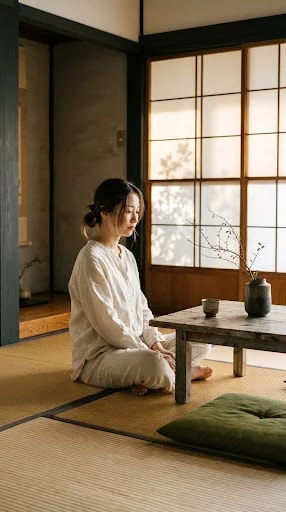
There is a particular sound a room makes when someone lowers themselves onto tatami: a soft compression, a rustle of woven rush, then nothing. Japanese design has always treated that moment as the point of the whole exercise. Before you choose a sofa or hang a picture, the room has already decided how you will enter it, where you will kneel, and what your hands will rest on. The space in the image is not empty because nobody has finished decorating it. It is finished. Every object in it earned its place.
The floor sets the rules. Tatami mats are modular, roughly a meter wide and twice as long, and traditional rooms are dimensioned around them rather than around furniture. That single decision changes everything above it: ceilings feel lower, tables shrink, and clutter becomes physically awkward because there is nowhere to hide it. If you want this feeling at home without importing a full washitsu, start with one mat-sized zone, about two square meters. Lay a rush or seagrass rug with a visible border, keep the surrounding floor bare, and let the edges of the rug act as walls. A single moss-green floor cushion placed off-center gives the eye somewhere to land without filling the frame.
Then comes the light. The shoji screen in the photograph does more work than any lamp could, потому that paper does not admit light so much as soften it, spreading a even glow that flattens shadows and makes the room feel lit from within. You can borrow the effect with a folding screen faced in rice paper, a linen curtain hung a hand's width from the glass, or plain washi-style shades over a warm bulb. Avoid anything that puts a bright point in your line of sight. The goal is a room where you cannot tell exactly where the daylight is coming from, only that it is there.
The low table is the quiet anchor. One table, low enough that a seated person can reach the cup without stretching, holding a single ceramic cup and one branch in a dark vase. Japanese interiors give that arrangement a name and a dedicated alcove, but the principle travels: one object receives attention, and everything else steps back. A branch is better than a bouquet because it has direction, a lean that echoes the architecture. Resist the urge to add a second vase, a stack of books, a candle. The composition holds because it is almost incomplete.
What you are really building is a corner that rewards staying. Sit down on the cushion, put your phone in another room, and let the mat be uncomfortable for the first five minutes. The room was never designed to entertain you. It was designed to make doing nothing feel like enough, and that is the rarest thing a home can offer.