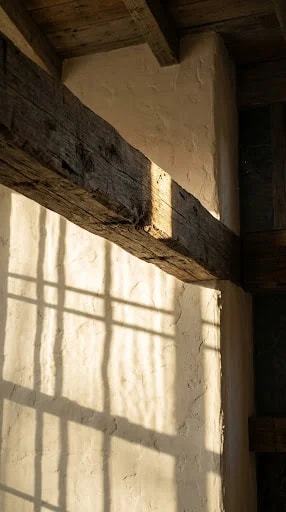
Walk into most ranch homes and your eye goes straight to the furniture. Walk into a good one and it stops at a corner where a dark timber beam cuts across a cream plaster wall. That junction is the whole story. In the image above, a heavy reclaimed beam runs diagonally through a tight vertical frame, hard afternoon sun raking across it from a window just out of sight. The window's grid lands on the plaster as a crisp cage of shadow, and for a moment the wall becomes the most interesting object in the room. No styling required, no accessories, no rug.
The plaster is doing half the work, and it is the half most often skipped. Hand-troweled lime or gypsum has a subtle undulation that flat drywall cannot fake; at a raking angle the surface reads almost like fabric, catching light in soft bands and dropping into shallow hollows. That irregularity is what makes the beam beside it look ancient rather than installed. If you are renovating, insist on a troweled finish with visible movement and skip the sanded-to-glass perfection — a dead-flat wall makes honest timber look like a costume.
The beam itself earns its weight. Weathered oak or elm, full of checks and open grain, darkened by decades of smoke and sun, brings a mass that balances all that pale wall. Finish matters more than species: a matte oil or soft wax lets the wood drink light and keeps the grain legible, while a glossy polyurethane turns it into plastic and kills the depth in exactly the light you bought the house for. Where a beam is structural, leave it exposed and celebrate the pegs and joinery. Where it is decorative, at least let it be honestly decorative rather than pretending otherwise.
Then there is the sunlight, which is really the third material. A window with a simple grid will throw shadows that shift across the plaster all day, sharp at noon, long and amber by late afternoon. That moving pattern is the cheapest art a ranch house will ever own, and it argues for restraint on the wall itself: resist the gallery arrangement of frames and shelves, and let one junction carry the composition.
What this detail teaches is proportion and patience. One strong beam, one textured wall, one window placed where the light can graze both. Get that intersection right and the rest of the room can stay quiet — a linen sofa, a worn wood floor, a single lamp. The rustic ranch look people chase with barn doors and signs is really just this: honest materials meeting at an honest joint, lit well enough that you notice.