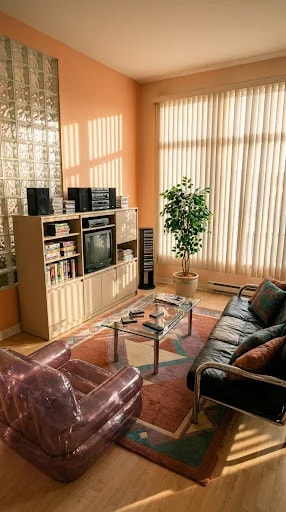
Before the flat screen liberated us, the television lived inside furniture. The 90s entertainment center was architecture: a beige laminate monolith deep enough to swallow a CRT, wide enough to hold a black stereo stack, and tall enough to make the ceiling feel lower. Look at the way this room orients itself. Everything points at that wall — the chrome-framed leather sofa, the glass-topped coffee table, the geometric rug whose angles seem to aim the eye forward. The media wall wasn't decor. It was the room's spine.
What makes the setup read so specifically 90s is the depth. A cathode-ray tube bulged backward nearly two feet, so cabinets had to be shallow in front and cavernous behind. That gave us the open shelf, the pass-through, the little glass door that revealed a VCR blinking 12:00. Stereo components stacked in their own bays, all black plastic and tiny green displays. If you're recreating the look today, borrow the proportions rather than the particle board: a low, deep oak or walnut console with open bays and one glass-front cabinet hits the same note while housing a soundbar and router. Nothing kills the illusion faster than furniture that's too thin.
The palette is the other giveaway. Peach walls, beige case goods, light wood trim — warm, dusty and unapologetically neutral until something loud interrupts it. Here the interruption is the purple vinyl armchair, and it works because the whole room has been quietly beige up to that point. Notice too how the glass block wall and the vertical blinds handle light. Sunlight rakes through the slats and lands as hard geometric stripes across the plaster, so the walls become graphic without a single piece of art. Vertical blinds are cheap, easy to find at any salvage yard, and — reasonably — they filter light like nothing else from the decade.
Then there's the greenery. A ficus in a woven basket, slightly too big for its corner, was the 90s answer to sterility. It softened all that laminate and gave the wide-angle shot a human scale.
To modernize the formula, keep three things and lose the rest: the deep warm-walled backdrop, the glass block or another glossy architectural accent, and a real conversation between a soft leather sofa and one absurd, shiny accent chair. Skip the faux-marble laminate and the tangle of cables. The 90s media wall was never really about the television. It was about a room that knew exactly where to look.