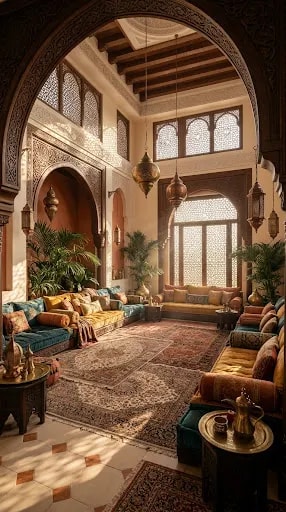
Standing at the threshold, the room arrives all at once. A single carved horseshoe arch, its plaster face worked with shallow relief, holds the entire scene the way a mat holds a painting: low banquettes running the perimeter, a stepped stack of patterned rugs, brass lanterns suspended at different heights, and beyond them a row of arched windows screened with mashrabiya lattice. The composition is symmetrical but not rigid. One palm leans slightly off-axis, a tea set rests where a hand last left it, and the eye keeps traveling inward because the arch has given it somewhere to go. This is the quiet trick of Arabic domestic architecture: the doorway does not simply admit you, it edits the view.
The furniture follows the same logic. Seating hugs the walls in long, uninterrupted runs, so the middle of the room stays open, cool, and walkable. Without arms and backs rising into the sightline, the architecture keeps its full height, and the carved beams overhead remain visible from any cushion. Color is handled in dense, saturated chords rather than scattered accents: gold, teal, and burgundy cushions grouped so each hue reads as a mass, then repeated in the rugs underfoot. Pattern on pattern works here because the values stay close and the scale differs, small hexagons against broad medallions, so the eye separates them without effort.
Light does the rest. Sun passes through the lattice and lands as geometry, thin lozenges and stars sliding across plaster and tile as the day turns. Brass warms whatever it catches, which is why lanterns and a simple tea tray earn their place in an otherwise formal room. The palette stays anchored in terracotta, sand, and caramel, with deep teal and muted red allowed in only where textiles can carry them. Nothing glares. Even at midday the brightest surface is a rug, not a wall.
For anyone borrowing from this room, the arch is the least expensive idea to steal and the most transformative. Frame a view rather than furnish a floor plan: pick the sightline you want from the doorway, then arrange seating to keep it clear. Repeat one shape, the pointed or horseshoe curve, in a mirror, a headboard, or a shelf niche so it reads as intent. Keep the palette to three warm neutrals and let two saturated colors do the talking. Finally, treat light as material. A pierced screen, a slatted shutter, or a single brass fixture will throw the same moving pattern that makes this majlis feel cool at noon and golden by late afternoon.