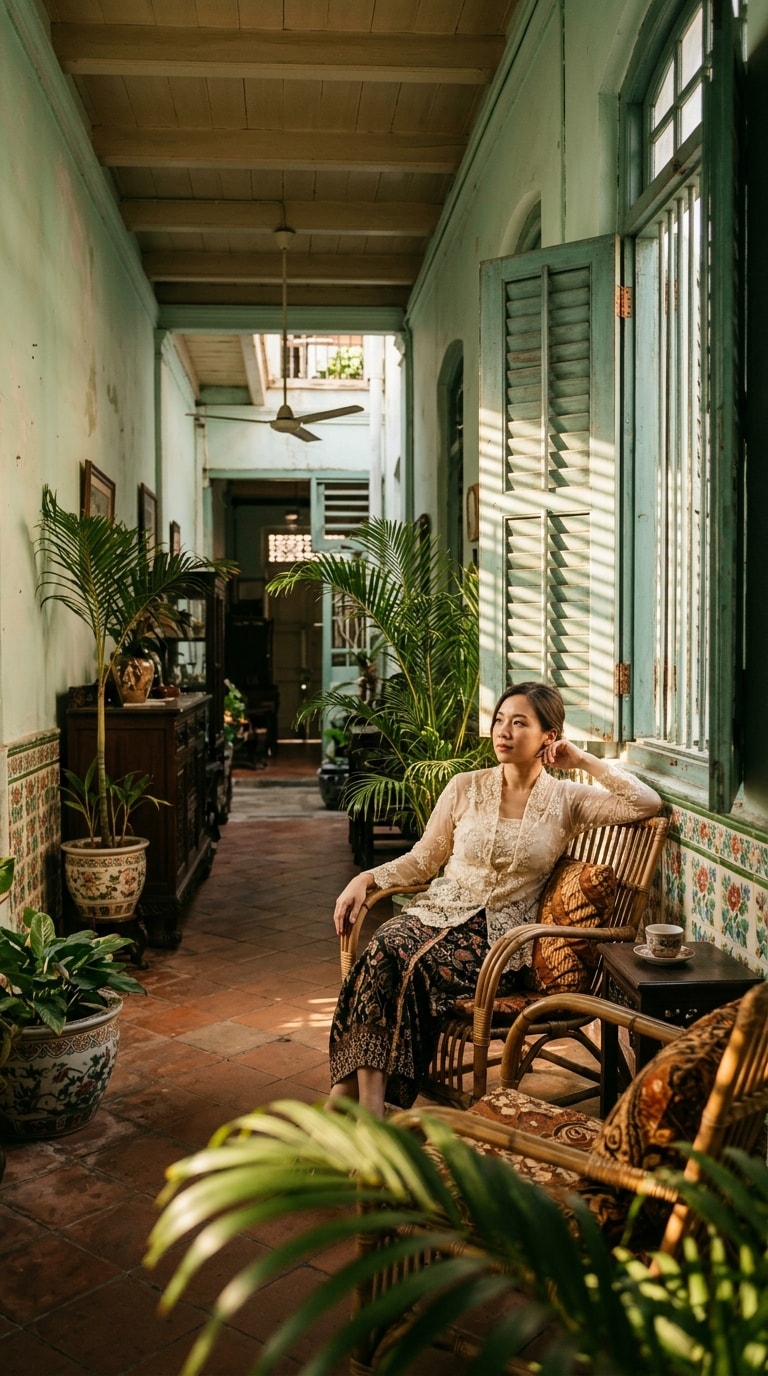
Walk down a Nanyang corridor at three in the afternoon and you will notice that the light has a pattern. It arrives in bands, angled slightly, sliding across the terracotta floor and climbing the pale wall behind a dark wooden cabinet. That geometry is not an accident of the sun. It is the shutter doing its job. Sage-green louvered panels, hinged in pairs along a deep window bay, act as a filter that can be opened, closed, or left half-tilted so the room shifts mood by the hour without anyone lifting a finger.
In the tropics, shutters were never purely decorative. They keep the monsoon out while letting cross-breezes through, and they allow a household to tune daylight the way a dimmer tunes a lamp. Fully closed, the slats throw a soft, diffused glow that suits a nap on a rattan armchair. Half open, they cast hard stripes that make even a plain corridor feel composed. The trick is depth: Nanyang homes set windows back from the walkway, so there is always a shadowed threshold before the bright garden beyond. That contrast between cool interior and hot courtyard is what gives the style its sense of shelter.
Underfoot, the floor does half the work. Vintage encaustic tiles in muted greens, ochres and creams hold colour rather than reflecting it, so the light that lands on them stays warm and matte. Where the original tiles are gone, plain terracotta is the honest substitute — it ages well, feels cool through the afternoon, and picks up the shadow lines of the shutters beautifully. Resist the urge to polish everything. A little patina is the point.
The furniture follows the same logic of quiet contrast. A tall, dark cabinet anchors the wall and gives the eye somewhere to rest between all that brightness. A rattan armchair, low and open-weave, sits lightly in the middle of the corridor rather than against it, inviting someone to stop walking and simply be there. Potted palms at the edges blur the boundary between inside and out, and their shadows double the pattern the shutters started. Notice how few objects there are — the composition works because nothing competes with the light.
To bring this into a modern home, start with one window and one pair of louvered panels in a soft green, grey or timber tone. Keep the palette to three earthy colours, choose furniture with dark weight and pale texture, and let the shadows be the ornament. A long corridor, a chair, a plant, and the patience to leave the walls alone will do more than any amount of decoration.