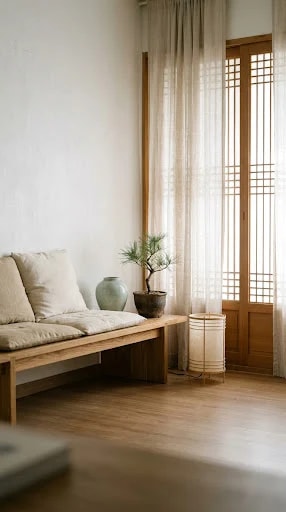
The most convincing Korean-style corners are rarely the largest ones. They are the narrow slices of a room that would otherwise become a corridor for stray shoes and unopened mail — maybe a metre and a half of wall beside a window, or the strip of floor next to a door you only use in summer. This nook works because it asks for almost nothing: a low bench, two cushions, a lamp, one vase. What makes it feel finished is not the amount of furniture but the discipline of stopping there.
Start with the bench. A pale, low platform in ash or oak, roughly knee height and no deeper than a seat cushion, does the structural work. It should read as a small piece of architecture rather than a sofa, so keep the legs simple or skip them entirely and let the frame sit close to the floor. On top, choose cushions that are thick enough to sit on for an hour and plain enough that you will not tire of them. Beige linen in a slightly warm tone holds up against wood far better than bright white, which tends to go grey in the corner where the daylight does not reach. Two is enough. Three starts to look like a shop display.
The backdrop matters as much as the seat. A traditional wooden door with grid-like latticework is the reason this corner feels calm rather than simply sparse — the repeated squares give the eye something quiet to rest on. If you have a plain wall instead, you can borrow the effect with a slatted screen, a paper panel, or even a length of sheer curtain hung to full length so it pools slightly at the floor. Sheer white fabric next to wood is one of the most reliable pairings in this style: it diffuses the light, softens hard edges, and hides whatever is happening behind it without blocking the brightness.
Keep the styling to three objects and no more. A celadon vase with a muted green glaze, a small bonsai pine in a shallow tray, and a cylindrical paper floor lamp are enough to establish the mood. The lamp is worth prioritising over almost anything else, because it changes how the corner behaves after dark: paper shades throw a low, even glow that makes a small seating area feel inhabited instead of staged. Place the lamp slightly behind and to one side of the bench so the light grazes the cushion rather than hitting you in the face.
Finally, resist the urge to fill the wall above. In Korean-influenced interiors, emptiness is doing deliberate work — it is what makes the corner feel like somewhere to breathe rather than somewhere to be photographed. Leave the plaster bare, or hang a single small piece at seated eye level. Then sit down with a cup of tea, notice that the light arrives from the side rather than overhead, and let the room be finished.