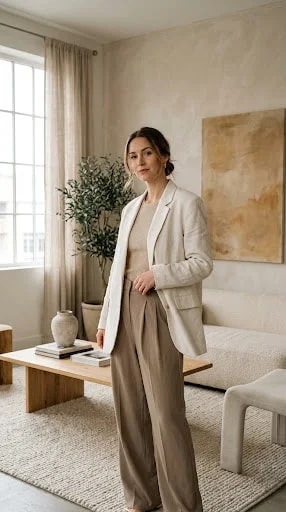
There is a reason the Zara style home reads as effortless rather than decorated. Look closely at a room like this one and you notice the same logic a good outfit follows: a narrow palette, a few contrasting textures, and one piece that does the talking. The woman in the cream blazer and taupe trousers is not matching her sofa by accident. She is wearing the room, and the room is wearing her back.
Start with the palette and treat it as a rule rather than a suggestion. Cream, sand, taupe, olive, soft brown. Five tones, no more, repeated across surfaces at different values so nothing flattens out. The beige sofa sits a shade lighter than the woven rug, which sits a shade warmer than the low wooden coffee table. That small stepping of tone is what makes a neutral room feel layered instead of beige-on-beige. If you are unsure where to begin, pull the palette straight from your wardrobe. The pieces you actually reach for are a reliable map of what you will still like living with in three years.
Texture is the second move, and it is where most neutral rooms fail. A flat palette needs contrast in the hand, not the eye. Here the sheer curtain does the light work, the rug does the soft work, the wood brings warmth, and the ceramic vase and sculptural white stool bring the hard, glossy note that keeps everything from looking like a cloud. Aim for at least three distinct surfaces in any sightline: something woven, something smooth, something matte. A tall olive tree earns its place for the same reason. Green is the one color a neutral room can absorb without breaking the spell.
Then there is the restraint. Notice how little is actually happening on the coffee table: books, one rounded vase, nothing else. The abstract canvas on the wall is earthy and quiet, low in contrast, so it supports the palette instead of arguing with it. This is the hardest part to copy because it asks you to subtract. Before you add anything, clear the surface and ask whether the room is better without it. Nine times out of ten it is.
Finally, let the light do the styling. Soft daylight from one side, sheer curtains diffusing it, shadows falling gently across the rug. Keep window treatments light and layer the room from the floor up so the eye travels. Dress the space the way you dress yourself, and the result will feel less like a showroom and more like someone lives there.