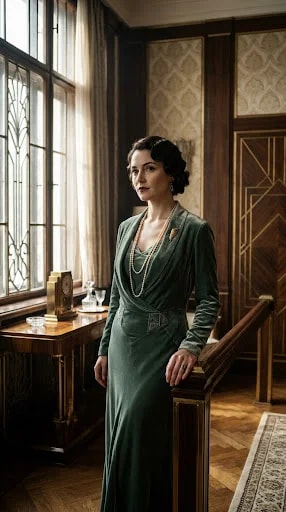
Look past the figure in the green gown and the room itself starts talking. The leaded glass window is the loudest voice — a grid of small panes set in dark came, tall enough that the light arrives in slices rather than a flood. Cream drapes hang at either side in heavy, deliberate folds, puddling just enough to signal that nobody here worries about vacuuming a hem. That combination, hard geometric glass against soft pooled fabric, is the whole 1930s argument in miniature: precision on one side, indulgence on the other.
The walls carry the second half of the story. Dark wood paneling runs to shoulder height, and set into it are lighter inlays arranged in stepped, angular patterns — the kind of marquetry that reads as plain wood from across the room and as a puzzle up close. Above the paneling, a damask covering repeats its figure in low contrast, so the pattern registers as texture more than ornament. This layering is worth copying. Most modern rooms pick one wall treatment and stop; a 1930s room stacks two, then lets a single metal accent cut through both.
That accent is the brass. A staircase banister curves through the frame with a warm, slightly tarnished sheen, and it does more for the mood than any piece of furniture could. Nearby, a polished side table holds a wooden clock and a small arrangement of glassware — modest objects, but placed with the care of a stage set. Notice how little is on the table. The era's best rooms were edited, not filled; the drama came from proportion and finish, not from quantity.
The palette follows from the materials: forest and olive greens, warm walnut browns, aged gold, and a cream that leans yellow rather than white. If you want this look at home, start with the fixed elements. A leaded or reeded glass panel, a run of dark paneling with a simple inlaid border, a brass rail or a brass-edged shelf. Then keep the upholstery quiet so the architecture can speak. Window light does the rest — sheer underlayers, heavy outer drapes, and nothing on the glass that flattens the shadows.
What makes these rooms endure is restraint paired with real craft. Every surface was chosen to be touched: the cool glass, the waxed wood, the metal that warms under a hand. Reproduce that sensibility and the decade follows on its own, no costume required.