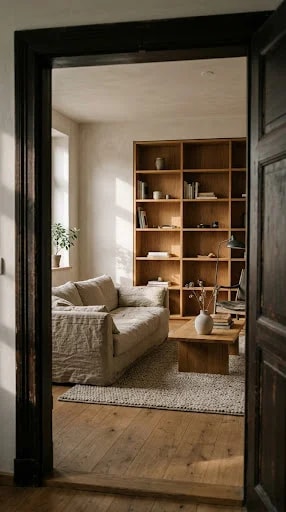
A dark timber doorway frames the room like a held breath. Beyond it, a cream linen sofa settles onto a textured off-white rug, a low oak table carries a single white vase of dried branches, and a light-wood grid bookshelf runs the length of the far wall. Nothing shouts. Everything has a place. That is the first thing anyone notices about German style home interior design: the confidence of a room that does not need to perform.
The German approach grows out of Wohnkultur, a word that treats living well as a discipline rather than a display. Order here is not coldness — it is courtesy. Shelves stay open because open storage demands editing, and editing forces you to keep only what earns its space. Books sit beside ceramics and a handful of small objects with no obvious value, and the mix reads as a life rather than a collection. The Bauhaus inheritance is present but gentle: form follows function, honest materials stay honest, and a chair is allowed to look like a chair.
Materials do most of the talking. Wide pale floorboards run without interruption, warm white walls hold the light, and honey-toned oak appears three times — table, shelving, floor — so the room rhymes with itself. Against that warmth sit charcoal accents and the muted green of a potted plant at the window, the only real colour in the frame. Textiles soften the structure: linen on the sofa, wool on the rug, both in oatmeal and cream, both chosen for how they will age. German interiors trust patina. They would rather buy once, well, than refresh every season.
Daylight is treated as a building material. It arrives from the left, rakes across the wall and the shelf edges, and casts shadows soft enough to read as texture. There is no elaborate artificial layering at midday; the room opens to the sun and closes down quietly at dusk. That restraint is the practical side of German design, and it is easy to borrow. Keep window treatments sheer. Put your best object where the light lands. Let the architecture — even when the architecture is only a doorway — do the framing.
What results is a space that feels lived in and composed at the same time, grounded rather than styled. You step through the dark threshold, and the noise of the day stops at the frame.