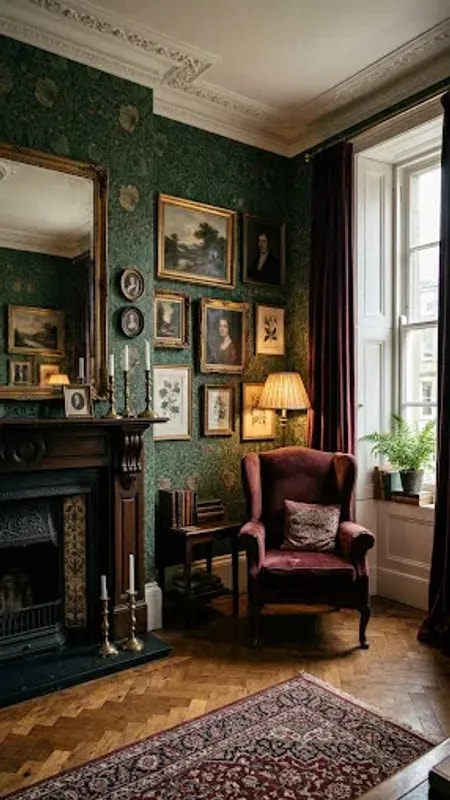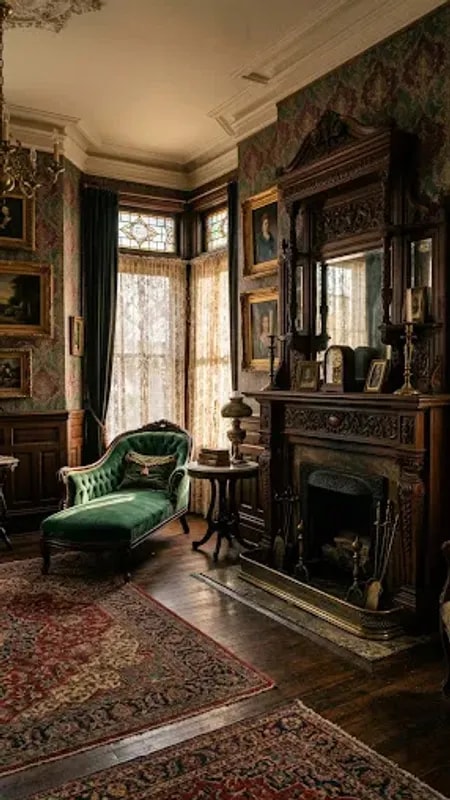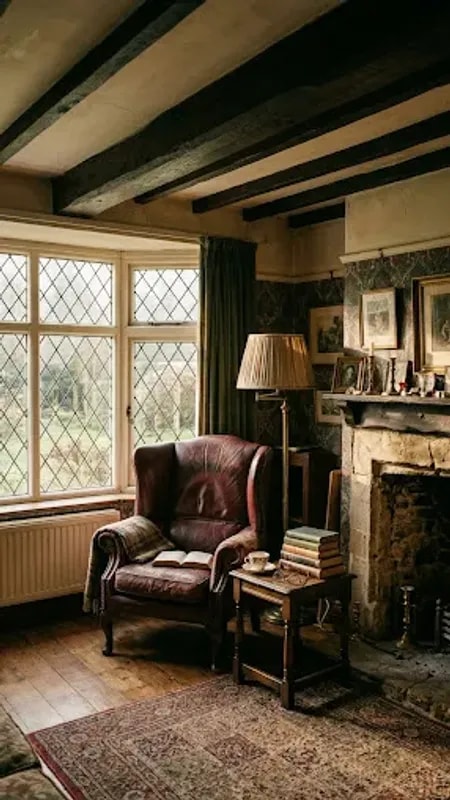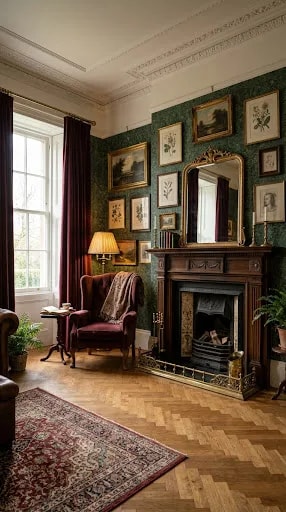
When a British room is at its best, it doesn't announce a scheme — it accumulates one. The corner in this sitting room is a case in point: a burgundy wingback pulled close to a cast-iron grate, a cluster of frames climbing toward an ornate cornice, and a tall sash window doing quiet battle with the fire for control of the light. Nothing matches. Everything belongs. That is the trick worth copying.
Start with colour, because heritage British interiors rarely begin with a neutral. The walls here carry a small-scale green pattern, dense enough to read almost solid from across the room, and the armchair answers it in deep red rather than fighting it. Keep the joinery, cornice and skirting a clean cream so the eye has somewhere to rest; without that pale ribbon running along ceiling and floor, the same palette would feel airless. A patterned rug in muted reds and browns ties the herringbone boards to both the wallpaper and the upholstery, so the floor never reads as an afterthought.
The fireplace earns its role as the anchor. A cast-iron grate with a brass fender gives the corner a centre of gravity, while the gilded mirror over the mantel throws window light back into the room — a useful move in narrow period spaces where daylight arrives from one side only. Let the gallery wall feel assembled over years rather than plotted on a grid: mismatched frames, a mix of oils, prints and small drawings, hung low enough that the bottom row sits at eye level when you are seated.
Then soften everything. Heavy curtains stacked at the window's edge, a lamp left burning in the afternoon, books piled on a side table within easy reach of the chair. British rooms are lit in pools, not washes, and it is the warm lamp glow meeting cool daylight that makes this corner feel inhabited. A candlestick, a pair of potted plants, one cushion slightly out of place — these are the details that separate a heritage look from a museum recreation.
If you take one lesson from the image, take the willingness to layer. Choose a pattern you can genuinely live with, give it a partner colour two shades deeper than feels safe, keep the architecture pale, and let the objects settle in over a few seasons. The corner will do the rest.