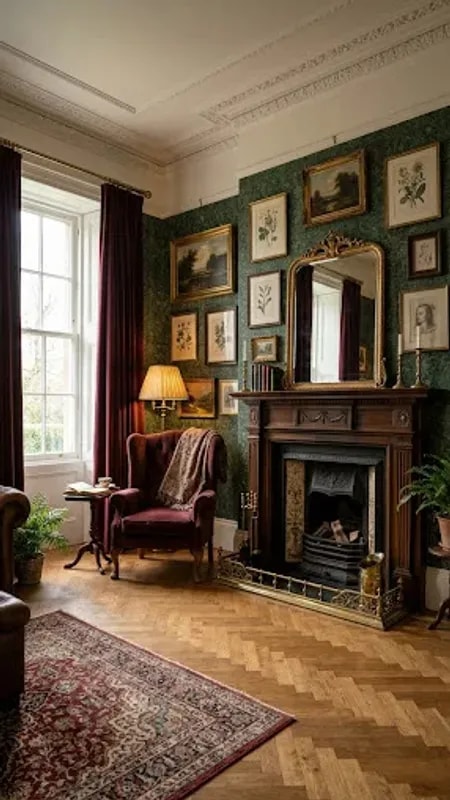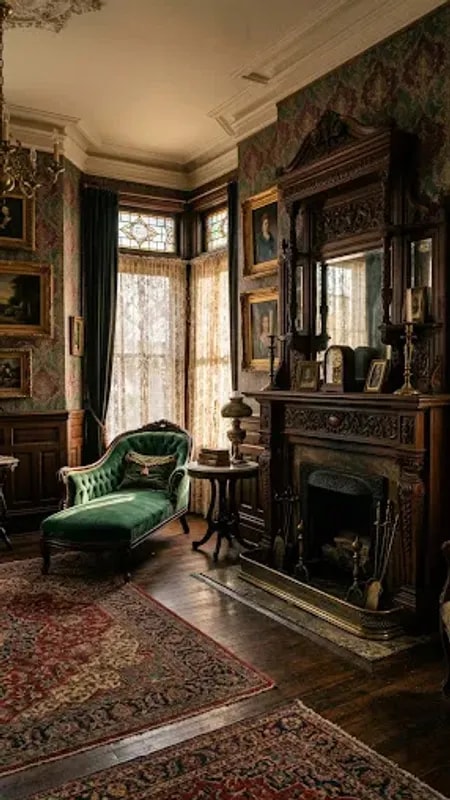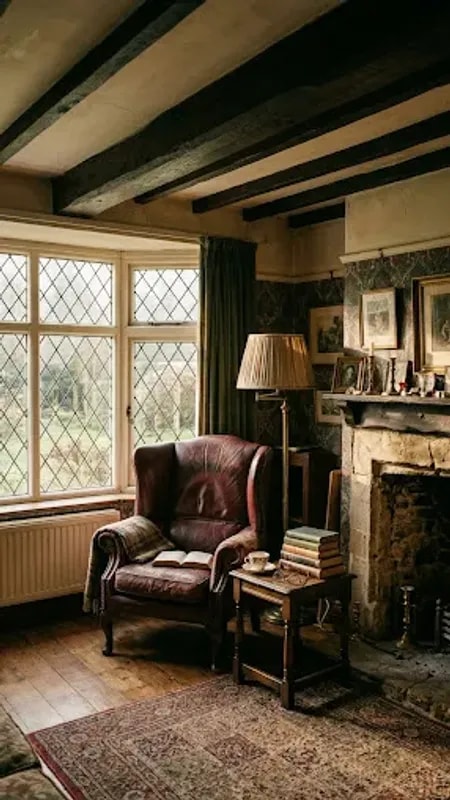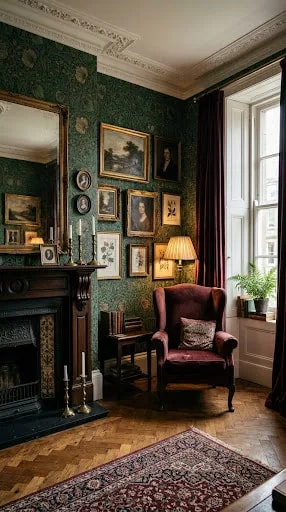
Every well-resolved corner has one piece that refuses to blend in. Here it is the wingback chair in deep burgundy, set against wallpaper the colour of a shaded garden. Put a green chair in that spot and the whole arrangement goes quiet to the point of disappearing; swap in something neutral and the wallpaper starts to look like a mistake. The burgundy works because it sits close enough to the green in depth and far enough away in temperature, so the eye reads contrast without reading conflict. This is the quietest possible argument for one deliberate clash per room.
The wallpaper is a floral of medium scale, dense enough to behave almost like a textile. That density is what makes the gallery wall above and beside it survivable. Portraits and small landscapes in gilt and dark wood are hung close, edges within a hand's width of each other, so the frames read as one textured mass rather than a scatter of isolated objects. Notice that the pictures are not matched in period or subject, only in weight. A tight hang forgives a mixed collection; a generous hang exposes it.
On the left, the carved wood fireplace and the oversized gilt mirror hold the structural side of the composition. The mirror is doing double duty: it catches daylight from the sash window opposite and throws a little of it back into the darkest part of the room, and it doubles the depth of a corner that would otherwise dead-end. Brass candlesticks on the mantel repeat the gold of the frame. Three golds, one wood tone, no more.
The lighting is the part most people get wrong when they chase this mood. Daylight through the window is cool and comes in low; the table lamp under its pleated shade is warm and sits at seated eye level. Neither source is bright. Together they produce the soft, slightly murky shadows that make a heritage room feel inhabited rather than staged, and they flatter dark green in a way that overhead light never will.
Underfoot, herringbone parquet in mid-brown oak and a patterned Oriental rug keep the scheme from floating. The potted fern by the window adds the one note of living green that isn't paint or paper. Everything here is arranged around a single assumption: that someone will sit down with a book and stay a while.