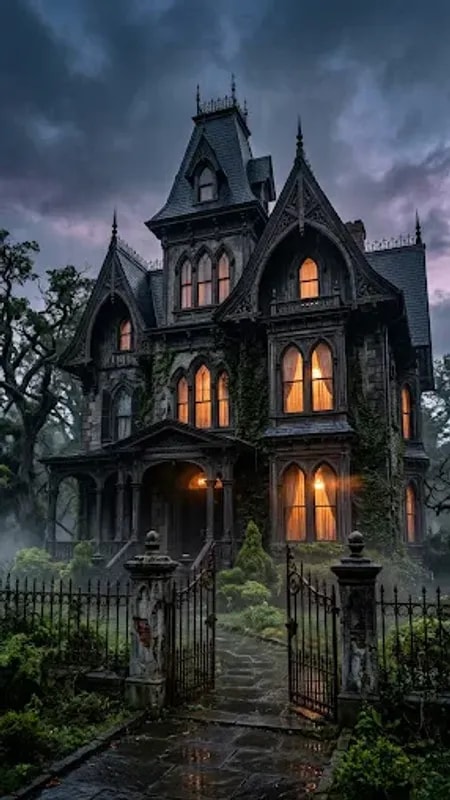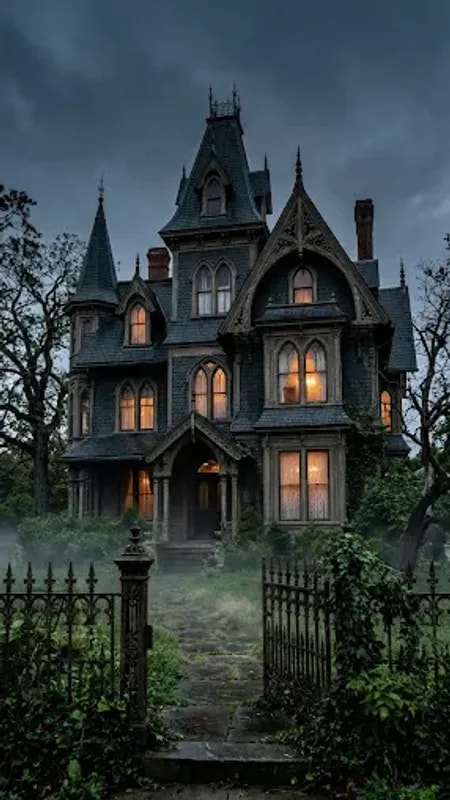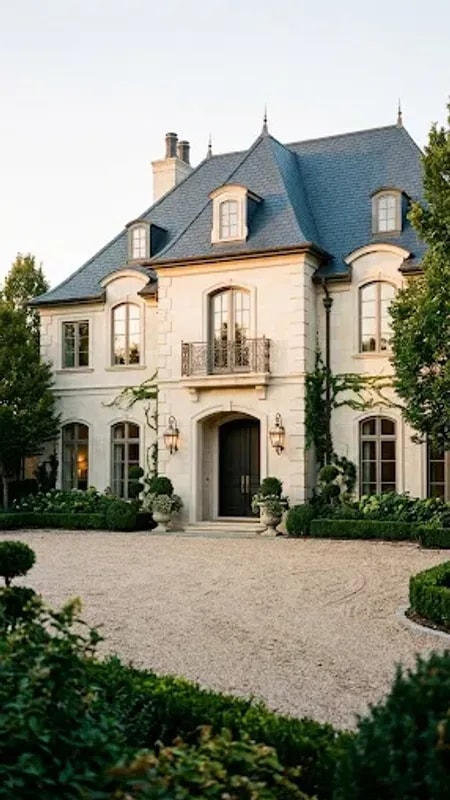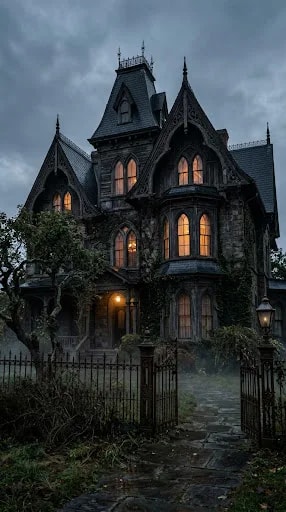
Stand at the gate of a Gothic Revival house at twilight and the whole composition resolves into one question: which parts glow, and which parts stay dark? In this straight-on view, the answer is generous but disciplined. Steep gables and a central turret climb toward a bruised blue-grey sky, the iron fence and bare tree hold the edges in silhouette, and a handful of pointed-arch windows burn amber against charcoal stone. Nothing is evenly lit, and that is precisely why it works. The house reads as inhabited rather than floodlit, and the eye travels from the stone path to the heavy door without ever being shouted at.
The governing principle is color temperature contrast. Dusk delivers cool ambient light, so every artificial source should run warm, roughly 2200K to 2700K, and stay dim enough that shadows survive. Interior windows do most of the emotional work here, so treat them as the primary fixture: layer warm lamps behind sheer curtains, keep brightness uneven from room to room, and let upper floors fall darker than the ground level. Outside, two or three low lanterns along the path are enough to suggest a route. Uplighting the spires is tempting, but a single grazing wash on carved trim will flatter the stone more than a wall of light aimed at the roofline.
The approach matters as much as the fixtures. This composition works because it is frontal and symmetrical, with the open gate acting as a frame rather than a barrier. A stone path that disappears into mist gives the entrance a sense of arrival and keeps the viewer moving forward. If your own entry is less architectural, borrow the structure: a gate or arbor to establish a threshold, a path that curves just enough to hide the last few feet, and planting that crowds the edges without swallowing the door. Bare branches and overgrown shrubs are assets in this style, provided they are pruned to read as deliberate.
Restraint protects the mood. Gothic style home exterior design is easy to overdo, and clutter reads as chaos rather than atmosphere. Stick to a tight palette of charcoal, slate, black iron, and muted greens, then spend your contrast budget on that orange-gold light. Keep trim shadows sharp by avoiding broad washes that flatten carving. Set lamps on timers and separate zones so the house shifts through the evening instead of snapping on all at once, and shield every exterior fixture so the glow lands on stone and foliage rather than on a neighbor's window. The goal is a house that looks like it has a story behind the door, and the fastest way there is to leave most of it in the dark.