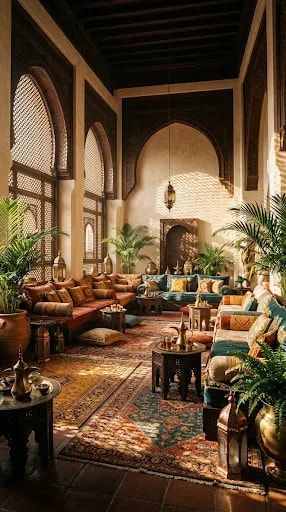
The first thing a majlis does is slow you down. In this room, tall arched niches rise on either side like doorways into the walls, each one holding a long, low banquette upholstered in rust red and deep teal. Cushions in mismatched patterns are piled generously along the length of the seating, and carved wooden coffee tables sit low enough that a tray of tea feels within easy reach. Brass lanterns hang overhead, terracotta floor tiles run cool underfoot, and potted palms push green against dark wood beams. Nothing in the space asks you to stand up and admire it from a distance. Everything asks you to sit.
The architecture is doing most of the work. The mashrabiya screens are not decoration — they are a climate strategy, turning hard sunlight into a soft, patterned glow that drifts across the floor through the afternoon. Those intricate shadows are the reason the palette works: rust, gold, cream and teal all read as warm rather than heavy when light keeps moving over them. The near-symmetrical composition, with the back arch centred and the screens flanking it, gives the eye an obvious place to land while the foreground tables and plants soften the approach. If you are borrowing this idea at home, start with one arched opening or a single screen panel rather than a full wall. Directional, filtered light is the effect you are after, not the geometry itself.
Seating is where the Arabic style departs most sharply from Western living rooms. Instead of a sofa facing a screen, the banquettes line the perimeter, encouraging people to turn toward each other. The low height keeps sightlines open, which is why the room feels expansive despite being full. Patterned cushions are essential but need discipline: keep two or three colour families and vary scale instead of hue, so a small geometric print can sit beside a larger floral without competing. Layer flat-woven rugs over a larger ground rug to define the conversation zone, and let the edges stay visible against the tile.
Materials carry the opulence without gloss. Carved dark wood, unlacquered brass, hand-thrown ceramics and terracotta all age visibly, which is part of their appeal. Add a few glossier accents, such as a pierced metal lantern or a mirrored tray, to catch the light and keep the mix from going flat. Palms and ferns are the finishing move — they break up the symmetry and introduce the one cool colour the room needs.
What makes the majlis worth copying is not the ornament but the intent. It is a room built around hospitality, where shade, a low table and a comfortable place to lean matter more than a focal wall. Start with the seating height, filter the light, then let the textiles accumulate slowly. The calm arrives on its own.