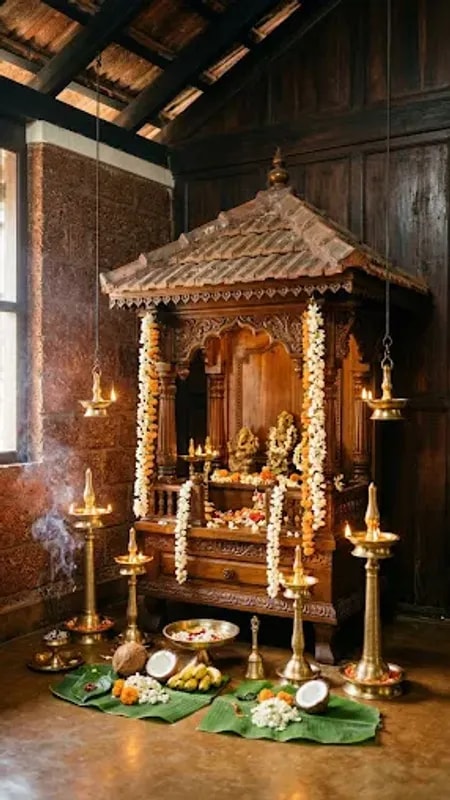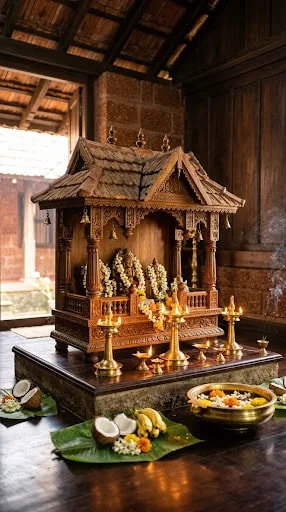
The heart of this corner is a miniature mandapam in dark, close-grained wood, lifted on a low platform of stone and timber so the shrine sits slightly above eye level when you kneel. Carved pillars bracket the opening, their brackets and lotus motifs picked out by warm daylight falling from the left. Behind it, paneled walls in deep mahogany keep the background quiet, and a bright stone doorway blurs softly at the edge of the frame, hinting at the rest of the house beyond. Nothing here is decorative for its own sake; every element has a job in the daily ritual.
Kerala temple carpentry, shaped by thachu shastra proportions, favors teak, rosewood and jackwood because they hold fine carving and age into a rich patina rather than looking worn. A home version scales the mandapam down to a metre or so, but keeps the grammar: a plinth, four slender pillars, a stepped roof form, and a small sanctum niche for the deity. If solid carved wood is out of reach, a hardwood frame with a painted or panelled back works well, provided the proportions stay generous and the joinery stays visible. Avoid high-gloss finishes. Oil, beeswax or a matt lacquer lets the grain breathe and suits the earthy palette of terracotta, brass and deep brown.
Placement matters as much as the piece itself. Traditional homes set the pooja room in the north-east or the thekkini, with the worshipper facing east or north, and the platform raised a few inches above the floor to mark the threshold between ordinary and sacred space. In an apartment, a recessed alcove, a deep cupboard converted to a niche, or the quieter end of a corridor can carry the same feeling if the shrine is kept clear of clutter and away from the foot of a bed. Wooden panelling behind the mandapam, even a single salvaged door, gives the enclosure that dim, incense-warmed depth the photograph captures.
The lamps do the rest. A nilavilakku in brass, with its tiered stem and row of wicks, throws a flickering gold light that no electric fixture matches, and it should stand to the left of the shrine with the wick pointing inward. Fresh jasmine strung across the mandapam, a brass uruli of water, and offerings laid out on a banana leaf — coconut, banana, loose petals — complete the arrangement. Keep the palette tight: brass, wood, white flowers, green leaf. Too many colours and the shrine starts to look like a display shelf.
For smaller homes, the honest approach is to shrink the footprint rather than the detail. A wall-mounted mandapam half a metre wide, one good lamp, and a single carved panel will read as authentic; a large, badly detailed unit never will. Expect to dust weekly, oil the wood twice a year, and let the brass darken between polishings. The reward is a corner that feels grounded, warm and quietly sacred — the same calm the image holds.