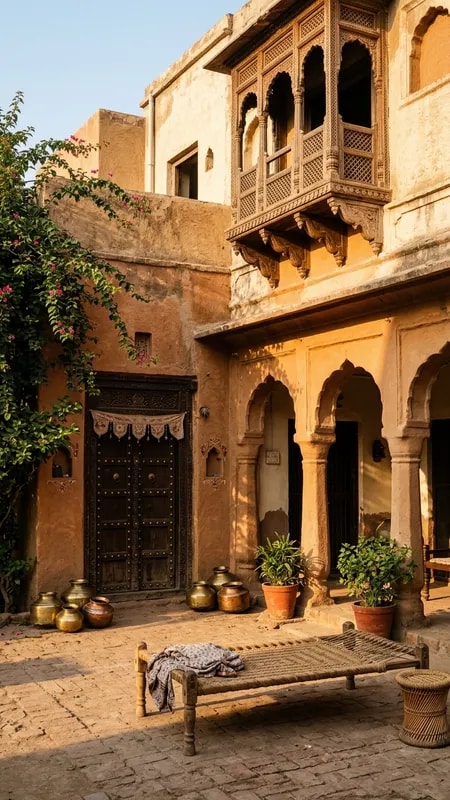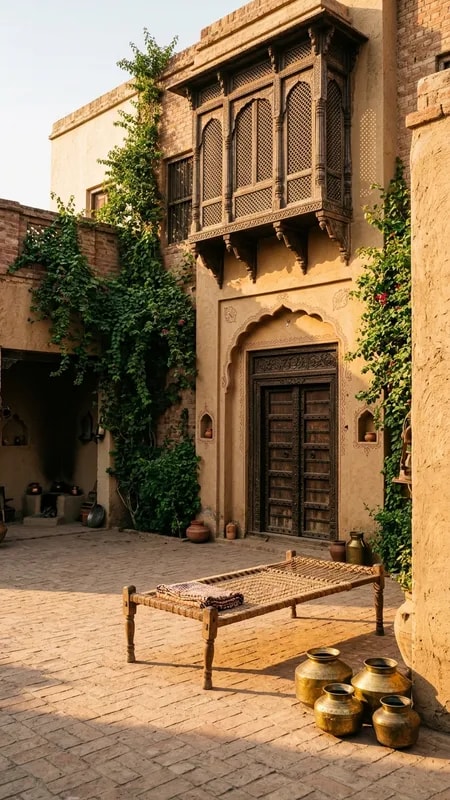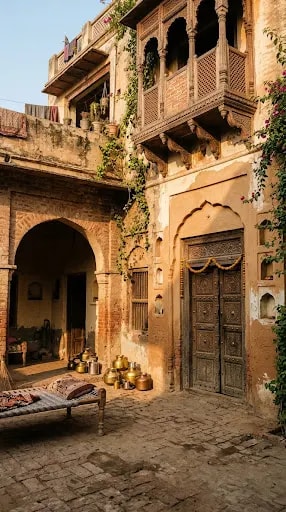
In this single Punjabi-style home, composition happens vertically. A carved wooden jharokha rises above a scalloped arch and a door thick with relief work, and the whole facade reads as a stack of invitations: balcony, threshold, courtyard floor. Golden light rakes across ochre plaster and exposed brick, deepening the shadows in the arched passage on the left. Below, a woven charpai sits in the foreground, brass and copper pots cluster near the steps, and a marigold garland hangs against the door. Nothing is staged; everything is in use.
The jharokha earns its place at the top. In traditional Punjabi and wider South Asian homes, this projecting balcony was never pure decoration: it catches cross breezes, throws shade onto the wall below, and gives the household a semi-private perch above the street. Here the carving is dense but the silhouette stays calm, a capping gesture that keeps the plaster facade from feeling flat. Its warm brown wood plays against the sandy ochre and the muted green of vines, a palette that feels grown rather than chosen.
At eye level, the door does the storytelling. Set into a scalloped arch, it is framed by small niches, potted plants and creeping vines that soften the masonry. The marigold garland adds a temporary note of color, the kind of detail that changes weekly and keeps a historic facade from hardening into a museum piece. Notice how the shadowed passage on the left gives the courtyard depth without adding square footage; a dark opening beside a bright wall is one of the oldest tricks in warm-climate design.
The ground plane is where utility becomes ornament. A charpai, woven tight, is both furniture and texture; brass and copper pots catch the low sun and repeat the amber tones of the plaster. Laundry drying on the upper terrace is not clutter but evidence of a working home, and the exposed brick patches read as honest patina rather than neglect. This is the balance that single-home design often misses: the willingness to let daily objects sit in the same frame as carved wood and arched openings.
For anyone designing a single home in a Punjabi style, the lesson is less about copying motifs than about stacking layers of use. Put something worth looking at high up, something welcoming at the threshold, and something practical at ground level. Choose materials that improve with weather, and leave room for garlands, pots and laundry to do their own composing. The result is a facade that feels inhabited from the first glance, warm in light, generous in shadow.