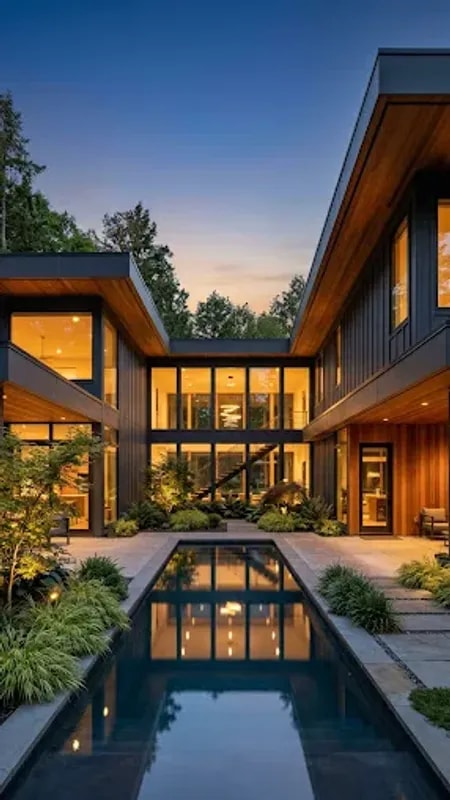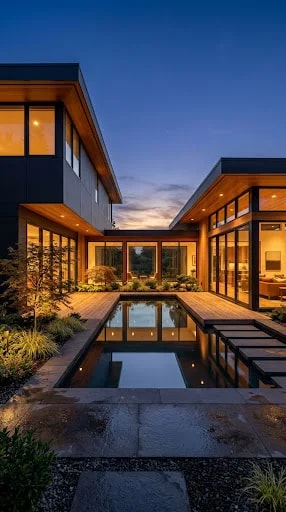
Most homes give you a doormat. This one gives you a bridge. At dusk, the two dark-clad wings of the L fold forward and the low glass pavilion stitches them together, and the only way in is a narrow plank walk that floats a few inches above a rectangular reflecting pool. The water holds the amber interior lights and the last of the blue sky at the same time. You step onto the first board, and the street behind you stops mattering.
The psychology of that threshold is the real luxury here. A courtyard pool creates distance without walls — you can see the front door from the curb, but you cannot walk straight to it. Those extra fifteen seconds of approach slow the pulse. Shoes sound different on timber than on stone pavers. The reflection doubles the height of the facade and makes the house feel larger than its footprint. By the time you reach the glass pavilion, you have already left the day outside, which is exactly what a well-planned entry should accomplish.
Materials do the quiet work. The wings are clad in a deep charcoal that disappears into twilight, so the honey-toned wood soffits glow from underneath and read as a continuous warm band across the composition. Broad windows are set back under those deep overhangs, letting interior light spill onto the decking without glare. Wide stone pavers in the foreground match the interior floor, tying the outside paving to the inside slab, while layered planting softens every hard edge and screens the neighboring lots. Nothing shouts. Everything is coordinated to a palette of navy, charcoal, honey, and muted green.
If you are borrowing this idea, a few details decide whether it sings or stumbles. Keep the bridge generous enough for two people to pass — around 1.2 meters — and keep its decking level with the interior floor so the transition is a single step, or none at all. Light the water from below the coping rather than from above; uplighting makes the pool a lantern instead of a mirror. Group the steps where they read as part of the composition, not as an afterthought, and repeat the same timber on the deck, the soffit, and the bridge so the eye traces one material through the whole arrival sequence.
The L-shape earns its reputation not because of the plan on paper but because of what it does to a person walking home. Two wings shelter the court, the water doubles the light, and a plank bridge turns the last thirty feet into the best part of the day.