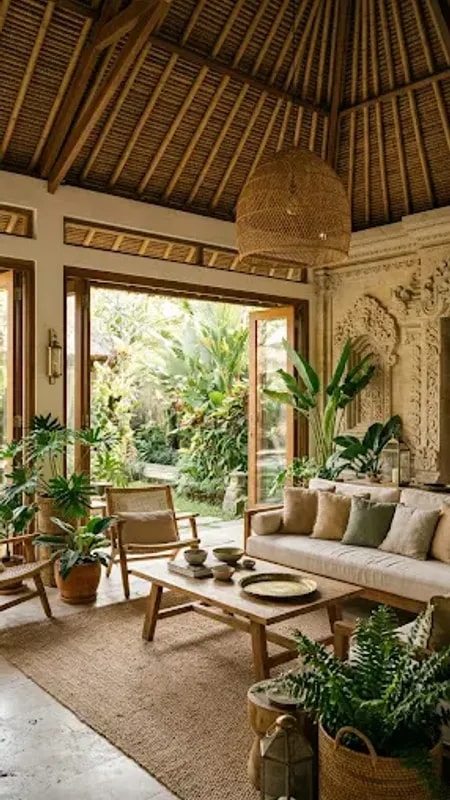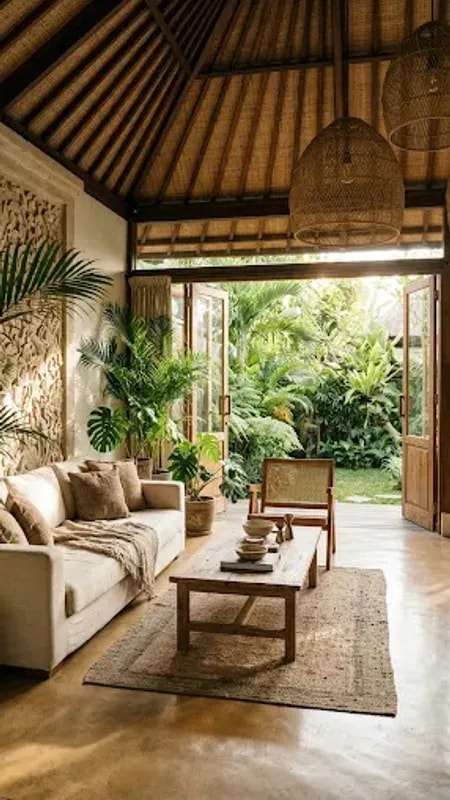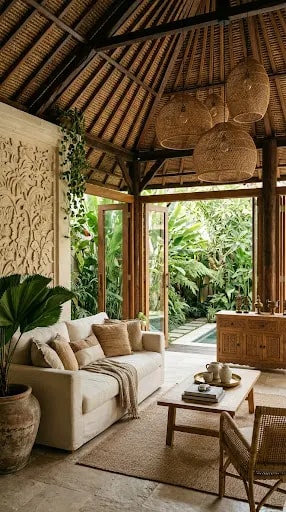
Stand at the threshold of a room like this one and the first thing you register isn't a colour or a piece of furniture — it's texture, stacked in layers from the peak of the roof down to the floor. A steep thatched ceiling of dark timber beams sits above clustered woven pendants, whose shadow patterns fall across a pale carved stone panel. Below, cream upholstery, a jute rug and a terracotta urn of elephant-ear plant hold the middle ground, while stone flooring runs straight out through open glass-and-wood doors into green. Nothing in the composition is glossy. Everything has a grain, a weave, or a chisel mark.
The recipe works because it follows a rough proportion. Roughly half the surfaces are matte and porous — thatch, rattan, jute, unpolished wood — which absorbs light and keeps the room from feeling like a hotel lobby. A quarter is hard and cool, the pale stone, the terracotta, the stone floor, giving the eye somewhere to rest. The remaining quarter is soft: the sofa, the textured cushions, the throw folded over the arm. Shift too far toward any one of these and the scheme collapses — all weave becomes a tiki bar, all stone becomes a spa reception, all linen becomes a showroom.
Colour follows the same logic. Honey-brown timber, cream, sand, terracotta and tropical green are all pulled from the landscape outside, which is why the boundary between indoors and out dissolves so easily. Rather than introducing a new accent, the room repeats what the garden already provides. The green of the plant echoes the foliage beyond the doors; the terracotta urn picks up the warmth of the timber; the cream sofa gives the eye a blank space to breathe between all that brown.
Light does the rest. Warm daylight arriving from the garden softens shadows and makes every surface legible — the roughness of the thatch, the grain of the sideboard, the matte finish of the urn. This is a room designed for daytime, which is a useful reminder that Bali style is not really about decorative objects. It's about how natural materials behave when the sun hits them.
If you're building the look at home, start with one large handcrafted anchor — a carved panel, a thatched element, a substantial timber beam — then layer weaves and soft textiles around it in decreasing scale. Keep the palette within four or five earth tones, leave the windows bare of heavy dressing, and let one living plant sit at the centre of the composition. Restraint is what separates a resort-like calm from a themed room.