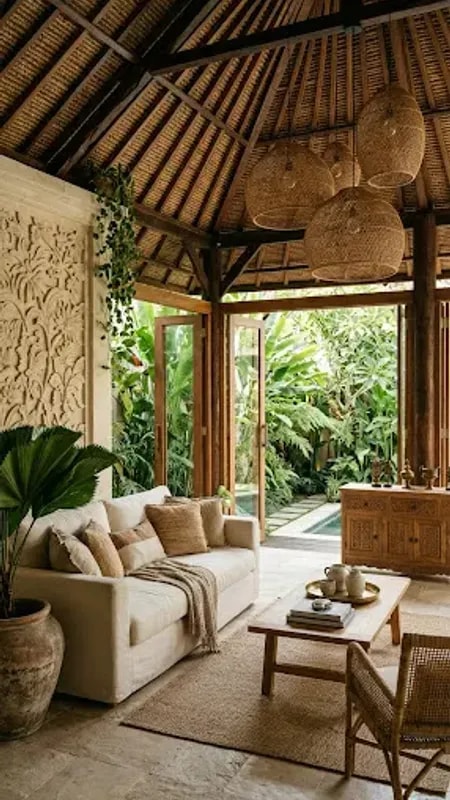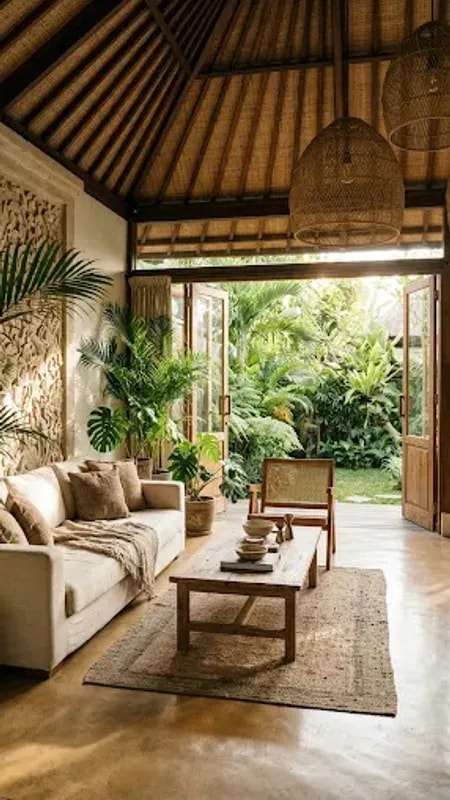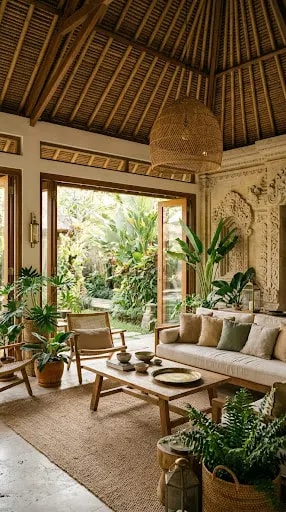
Most conversations about Bali style home interior design stop at the threshold — the sliding doors, the disappearing wall, the garden that wanders in. Look up instead. In this open-air lounge, the ceiling is the real architecture: a steep vault of bamboo rafters and thatch that lifts the eye and lets hot air climb away from the sofa. The room's generosity isn't measured in square metres but in cubic ones. Height is the quiet luxury here, and it costs nothing but courage with the roofline.
Hanging into that volume, a single oversized woven pendant acts as the anchor. It is deliberately large — anything smaller would be lost in the rafters — and its open basketweave lets daylight sift through in a soft lattice before the lamp is ever switched on. Beneath it, the seating stays low: a cream sofa with earthy cushions, rattan armchairs, a low wooden coffee table bearing ceramics and a tray. Low furniture under a high ceiling is the oldest trick in tropical design, and it still works. It makes the ceiling feel taller, the proportions calmer, and the person sitting there feel pleasantly small.
Behind the seating, a carved stone feature wall provides the counterweight. Where the roof is light and porous, the stone is dense and cool; where the thatch filters, the stone holds. Against it, potted plants and stacked baskets read as sculpture rather than clutter. The palette never strays far from the materials themselves — honey wood, cream, sand, stone beige — with tropical green doing all the accent work through the open doorway. A woven rug defines the conversation zone without closing it, and a fern in the foreground quietly blurs the line between inside and out.
The lighting does the rest. Daylight arrives from the garden side, bright and slightly blown out, then lands softened on the interior — warm shadows, gentle gradients on the stone, a glow along the bamboo. Nothing in the scheme fights that natural direction. No glossy finishes, no cool whites, no furniture angled to face a screen. The result is a room that feels restorative before anyone has done anything restorative in it.
If there is a lesson to borrow, it is to design upward as carefully as you design outward. Give a garden-facing room real height, hang one bold woven piece into it, keep the furniture low and the materials honest, and let the greenery supply the colour. The garden may move indoors, but the room should still be able to exhale.