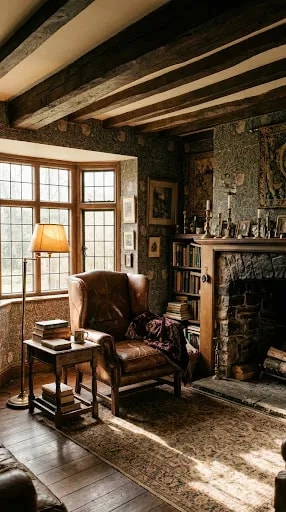
Some rooms are built around a fireplace; this one is built around a window. The bay projects out from the wall like a small wooden room of its own, its multi-paned glazing divided into narrow vertical strips of daylight. Everything else arranges itself around that geometry. The tufted leather chair sits slightly off-axis, angled not at the room but at the light, so whoever sinks into it faces the panes rather than the doorway. A side table crowds in close on the left, stacked with books that have clearly been read rather than arranged, and a brass floor lamp leans over the whole grouping like a conspirator. It is a nook in the oldest sense: a place that was going to exist anyway, simply furnished so it could be used.
The lighting is the part most people get wrong. Daylight through small panes is not soft, even light; it arrives in stripes across the rug and leaves the corners of the room in deliberate darkness. Rather than fight that contrast with a bank of downlights, the floor lamp answers it in the same register. Its glow is warm, low, and directional, catching the tooled surface of the leather and the gilded spines on the shelf without ever flattening the scene. Two sources, one cool and one amber, is enough. The rest of the room can stay dim, and should. Old English interiors were not lit evenly, and the shadows tucked behind the beams and under the mantel are as much a material as the oak.
Texture does the heavy lifting. The wallpaper here is dense and dark-grounded, its repeating motif close enough in value to the panelling that it reads as a surface rather than a pattern, which is exactly why it can survive beside a patterned rug without argument. Dark timber beams cross the ceiling, a stone fireplace roughs up the far wall, and the rug's muted golds and greens tie the floor to the chair. The trick with this much going on is not subtraction but weight: every layer is deep in tone, so nothing shouts. Add one pale, glossy, modern object and the whole composition would collapse.
Furniture in a space like this should be sparse and slightly tired. One chair, one table, one lamp. A second seat would turn a private refuge into a conversation area and kill the atmosphere instantly. The leather is cracked at the arms, the table edge is chipped, and the candle stubs on the mantel have burned down unevenly, all of which does more for the mood than any amount of styling.
If you want to borrow the effect, start with the window recess and work outward. Choose a chair that fits within the bay's depth rather than blocking it, layer a rug that repeats the wallpaper's palette instead of matching it, and give yourself one warm task light you can reach from the seat. Leave the corners alone. They are doing the work.