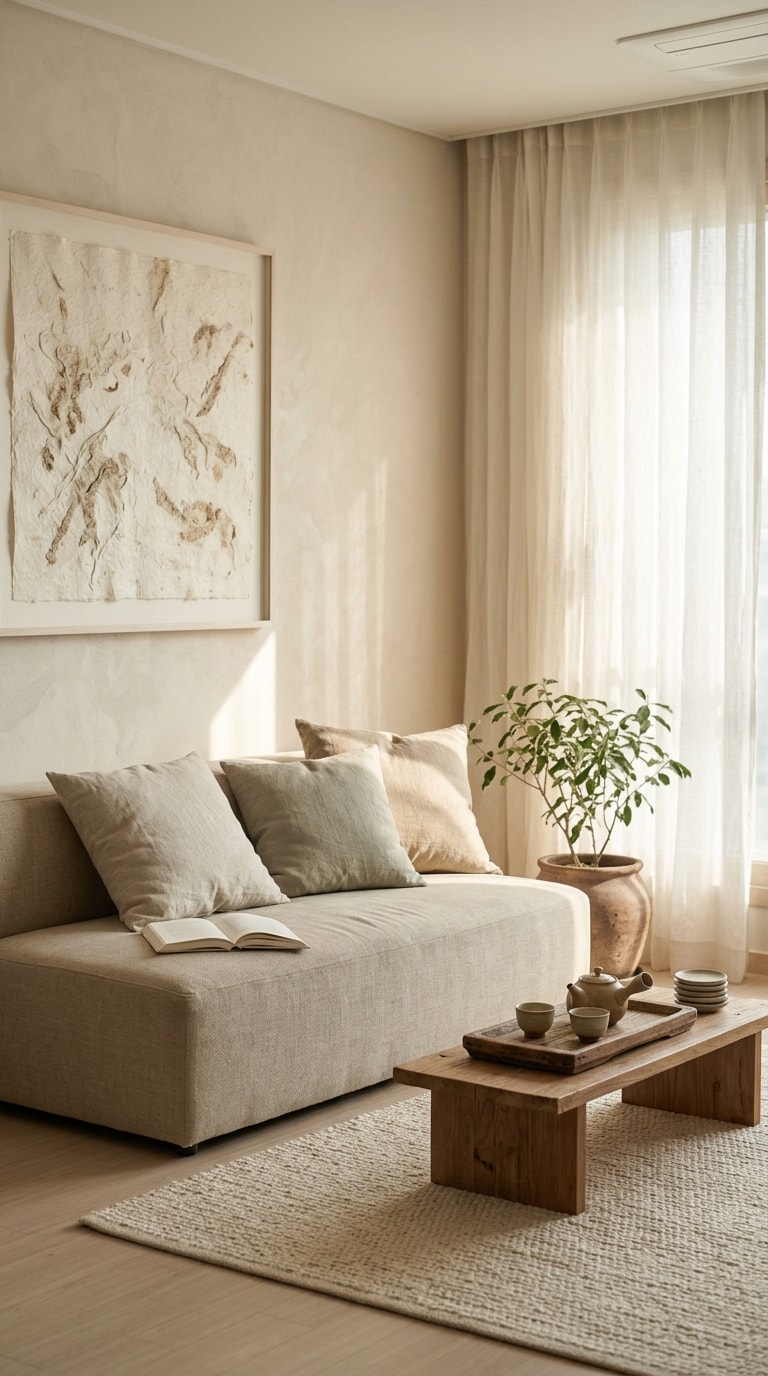
Walk into a Korean-style living room and the first thing you notice isn't a color or a statement piece. It's the horizon line. Everything sits low. The back of the beige linen sofa barely reaches the windowsill, the coffee table hunkers just inches above the woven rug, and your eye travels in a slow, flat sweep rather than climbing a wall of furniture. That low center of gravity changes how the room feels before you've consciously registered a single object in it. Nothing towers. Nothing asks you to stand at attention.
The table is the anchor of that arrangement. In this room it's a chunky slab of warm wood, thick enough to read as furniture rather than a surface, and on it sits a tea tray: a small pot, two cups, a shallow bowl for whatever came out of the kitchen that morning. This is the detail that separates the look from plain minimalism. A sparse room can feel like a showroom; a sparse room with a tray of used cups feels inhabited. The table is low enough that you reach it from the sofa without straightening up, which means the whole ritual of pouring, sipping, and setting the cup back down happens inside the same relaxed posture. Put an open book on the sofa seat and you've told the entire story of an afternoon.
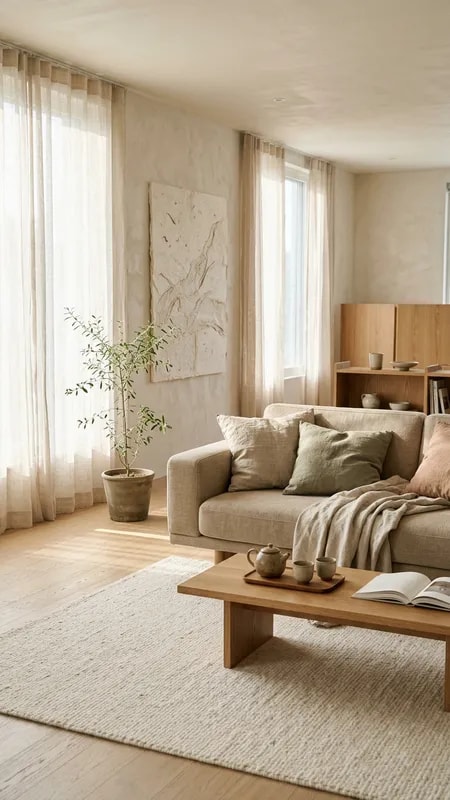
Texture does the work that pattern usually does. Linen on the sofa, wool underfoot, unglazed ceramic on the plant pot, the papery weave of the artwork above the sofa — all of it in a narrow band of cream, beige, taupe, sage, and honeyed wood. Because there's so little contrast, your attention moves to how things feel rather than how they look: the slack in a cushion cover, the grain in the table's edge, the blunt honesty of a hand-thrown bowl. Layering matters here too. The rug floats over pale wood floorboards, the tray sits on the rug, the cups sit on the tray, and each layer catches a slightly different light.
Light is the quietest material in the room. Sheer curtains hold the daylight back just enough to erase hard shadows, so the corners stay soft and the plant's leaves glow instead of glinting. That diffusion is why the palette doesn't go flat — the same beige reads warm near the window and greyish in the far corner, and the empty wall space between the art and the curtains gets to breathe.
To build the effect at home, resist filling the room. One low seat, one substantial table, one plant, one piece of art with actual surface texture, and a tray with things you genuinely use. Push the furniture away from the walls, keep the window covering sheer, and leave the upper third of the room empty. Restraint is the whole method — and the reward is a room that quietly asks you to sit down.