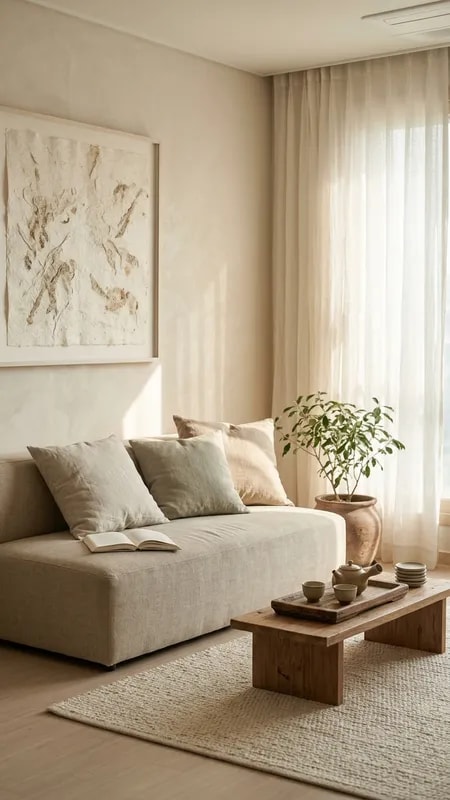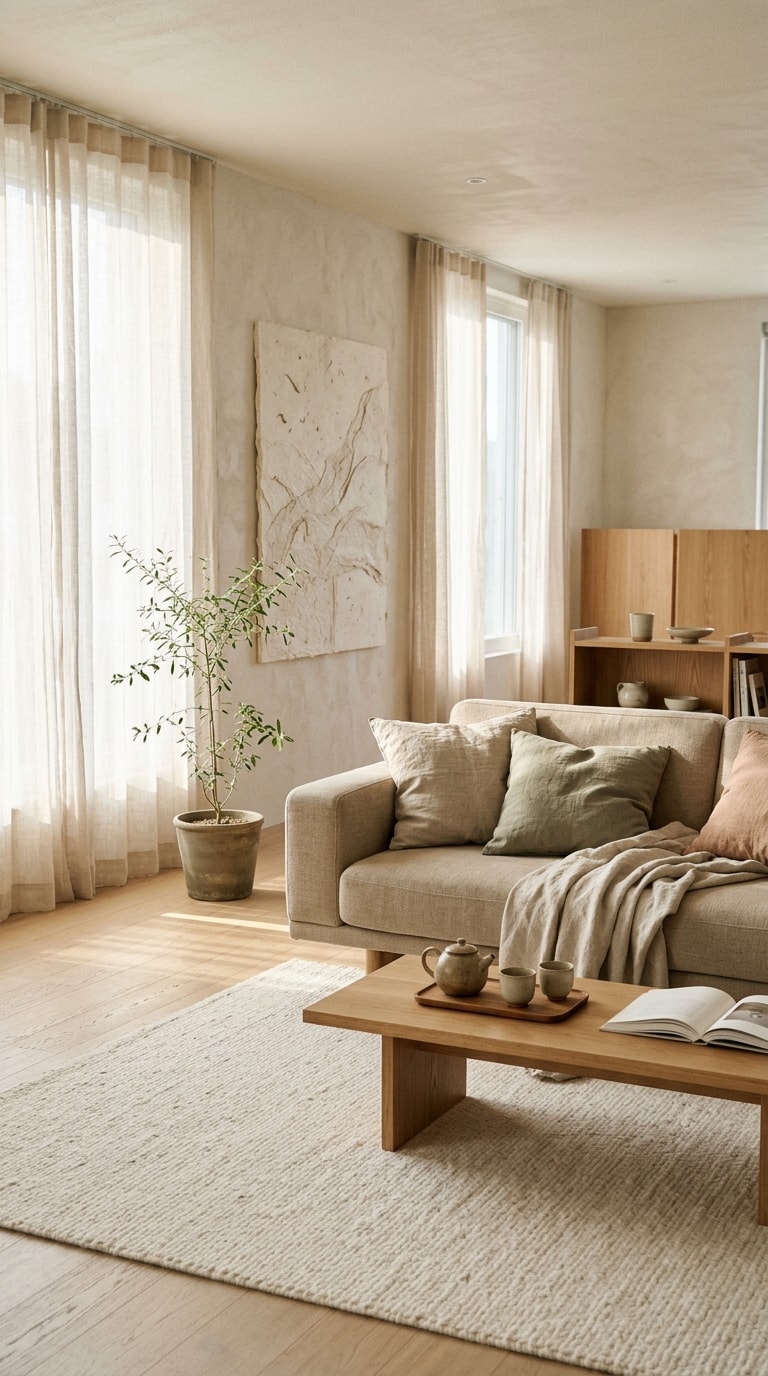
Morning light arrives sideways in this room, slipping through full-length sheer curtains and landing in soft bands across a cream rug. Nothing in the space asks to be looked at first. The eye settles instead on the low beige sofa, its seat height barely above the knee, dressed in sage-green and blush cushions with a throw draped rather than folded. It is a room built around the idea that you might stay a while, and that the furniture should not make a performance of it.
The palette does most of the quiet work. Oatmeal, warm off-white, pale wood, and a muted green that reads almost grey in shadow — these are colors that forgive mess and flatter daylight. Blush appears only twice, as cushion accents, which keeps it from turning sweet. Korean-style interiors tend to favor this kind of tonal restraint over contrast; instead of a statement wall, you get a tall abstract canvas leaning against the plaster, its soft washes picking up the same creams and greens as everything else. Texture carries the visual interest that color is asked to carry elsewhere: the nubby rug, the linen throw, the matte ceramic glaze on the shelving unit behind the sofa.
Low furniture changes how a room is used, not just how it looks. Sitting closer to the floor pulls the ceiling up and makes the space feel taller than it is, and it turns the coffee table into a work surface rather than a display. Here the table holds a wooden tray with a small teapot and two cups and an open book, page down. That arrangement is the whole philosophy in miniature: tea for two, one book, nothing else competing for attention. Leave a tray out and the room reads as inhabited. Style it too perfectly and it reads as a showroom.
Balance in the composition comes from opposing weights. The sofa anchors the right; on the left, a slender potted plant and the leaning canvas hold the corner without crowding it. Behind, the pale wood shelving stays sparse — a few ceramics, a handful of books with spines turned inward. Negative space is treated as a material here, as deliberate as the oak. Korean design traditions have long valued the pause between objects, and that instinct translates easily into contemporary rooms that would feel cluttered with one more vase.
If you want to borrow the mood, start with the light. Swap heavy drapery for sheers that filter rather than block, then lower your seating and pull everything a little away from the walls. Choose three warm neutrals and one muted accent, and let texture do the rest. Then resist the urge to fill the shelf.