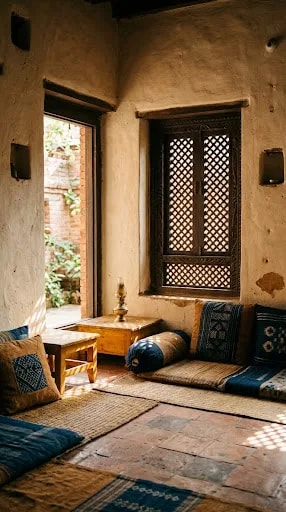
Some rooms ask you to look at them, and others ask you to sit down. This one belongs to the second kind. Its power comes from three things working together: an earth-plastered wall with a rough, hand-smoothed surface, a carved wooden window whose lattice throws a net of light across the floor, and an open doorway that lets a courtyard of brick and green leaves leak indoors. Nothing in the room is expensive in a showroom sense. Everything in it has weight, grain and a shadow.
Start with the wall. The ochre glow in this space is not paint; it is clay and lime plaster worked in thin layers and left with its trowel marks intact. If you want that finish at home, ask a plasterer for a lime or clay topcoat tinted with natural pigments, then resist the urge to sand it flat. Sample panels are essential, because clay plaster shifts colour across the day, warming in afternoon light and turning almost olive in shade. Seal it with a breathable natural soap or silicate finish so it can still move with the seasons, and keep the lower wall a shade deeper than the upper to mimic the way dust and weather settle in older Nepali homes.
The room's composition is really a pair of frames. The doorway on one side and the carved window on the other set the eye moving outward, from shadow to sunlight, which makes a small corner feel far larger than its dimensions. Protect that sightline. Keep the floor path to the door clear, place the seating low so it sits below the window sill, and choose terracotta floor tiles in a warm, slightly uneven tone rather than a flat, sealed red. If you cannot find an antique lattice window, a good carpenter can build one in sal or teak using traditional jali geometry; hang it as a fixed panel with a plain glass sheet behind it if the opening needs to be closed.
Textiles do the rest. Against all that ochre, indigo block-print cushions and bolsters read almost as a complementary colour, which is why the palette here feels deliberate rather than accidental. Lay woven floor mats first, add firm cylindrical bolsters for back support, and keep the count of objects low: a small wooden table, one brass oil lamp, a single ceramic cup. The brass matters more than it seems — a little polished metal catches the incoming light and keeps the darker corner from going flat.
Finally, plan for shadow. Deep, dramatic pools of dark are what give this interior its calm, and electric light can destroy them in an evening. Use one warm source at low level rather than a grid of ceiling downlights, let the window do the work by day, and leave the doorway unlit so the courtyard stays the brightest thing in view. The room is finished when the light, not the furniture, becomes the main event.