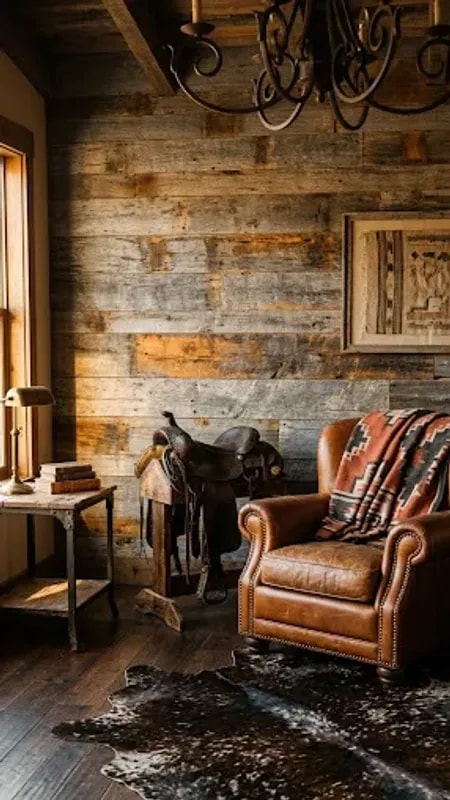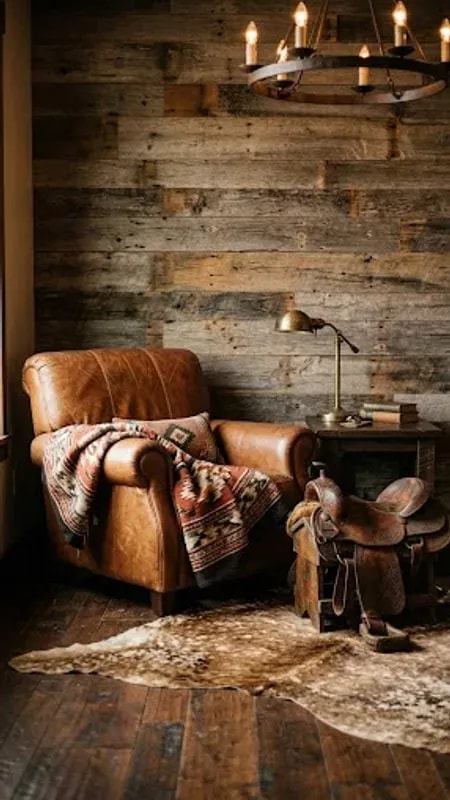
Most western rooms fail in the same way: too many artifacts competing for attention. Saddle, spurs, cattle skulls, rope, branding irons, all shouting at once. The room in this photograph does the opposite. It picks one heroine, a deep cognac leather armchair creased and darkened at the arms, and lets everything else step back into supporting roles. That chair is not styled; it looks like it has been sat in for twenty years, and that is exactly the point. Start your own room by asking which object deserves to be sat in, not just looked at, and build outward from there.
The backdrop does quiet work. Reclaimed wood planks run floor to ceiling in weathered gray-brown, giving the light something rough to catch and the leather something matte to sit against. If you are recreating this, resist the urge to sand or seal away the texture. Skip drywall entirely on one wall, or use a wide-plank shiplap in a matte finish, and keep the color within a stone's throw of the chair: tan, driftwood, faded barn gray. The harmony comes from restraint, not from matching.
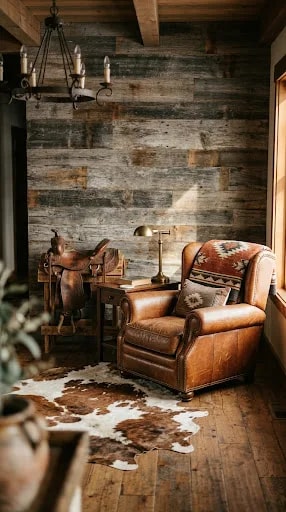
Then comes the layering, and it happens in threes. A patterned Southwestern blanket folded over the chair's back, a cowhide rug in brown and white over warm hardwood, and a leather saddle resting on a stand to one side. Each adds a different texture rather than a different color story, which is why the palette holds together in browns, tans, and shadow. Note the small brass lamp on the side table: one warm metallic note is enough to keep all that organic material from turning muddy. Add a single wrought-iron fixture above and stop there.
Light is the fourth material in this room, and it is doing more than any accessory. Sunlight enters from the right, rakes across the plank wall, and throws long shadows that make the corner feel deep instead of flat. Position your anchor chair perpendicular to a window rather than facing it, so the light grazes the leather and the wall behind it instead of blowing out the view. A linen shade on the lamp diffuses the evening glow the same way the window does at noon.
The final lesson is about what you leave out. The foreground of this image is deliberately soft, just a vase and empty floor, and that emptiness is what makes the chair feel like a destination. Give your western vignette a few feet of breathing room, keep the palette under four tones, and let one worn object tell the story. The room will feel less like a themed set and more like a place someone actually lives.