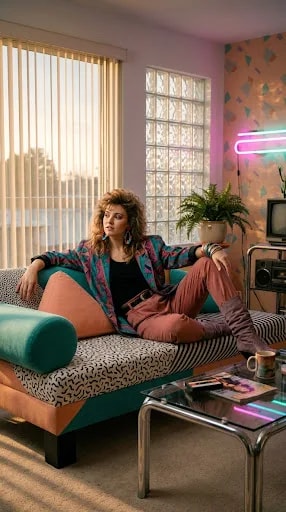
Late afternoon light slips through vertical blinds and lands in stripes across a geometric sofa upholstered in teal, peach, and black-and-white patterns. A woman in an oversized floral blazer and salmon trousers reclines there, one arm draped over the back, and the whole scene feels less like a showroom and more like a favorite aunt's apartment on a Sunday in 1987. The glass block wall glows softly. A fern unfurls beside a vintage television. A pink neon sign hums above the coffee table. This is 80s style home interior design at its most relaxed: saturated, a little kitschy, and completely lived in.
The sofa does most of the talking, and that is the first lesson. Choose one patterned anchor piece, then let it dictate the palette. Here, teal and peach repeat in quieter doses—the blinds, the neon, the magazines—while chrome and glass stay neutral. The glass block wall adds texture without competing, filtering daylight into something soft and cinematic. A chrome-legged coffee table holds a mug and a fan of magazines, proof that retro rooms need not be precious. Even the vintage television earns its place as sculpture, its dark screen reflecting the room back at itself.
Color makes the time capsule work. Pastel teal and peach keep the scheme from turning harsh, while magenta neon supplies the jolt. The woman's patterned blazer echoes the upholstery, but her solid salmon trousers show the balancing trick: when prints get loud, give the eye one calm, solid plane. In a modern room, aim for roughly sixty percent warm neutral, thirty percent pastel, ten percent electric accent. Chrome ties the metals together, and a fern or two softens all that glass and lacquer. The result reads nostalgic without tipping into costume.
To bring this energy home without recreating a museum, pick two signatures and let the rest stay contemporary. A geometric sofa and a glass block partition are enough; add LED neon, vertical blinds, or a chunky television only if they earn their square footage. Layer lighting so the room works at noon and after dark, and keep surfaces curated rather than cluttered. The magic in this photograph comes from sunlight, a relaxed pose, and a mug that has clearly been used. A great 80s room should feel like a time capsule you can actually live in, not a set you are afraid to touch.