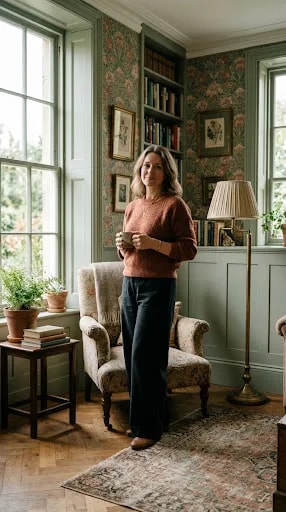
A certain kind of British living room never announces itself. You notice the light first, thin and silvery through tall sash windows, then the walls — a soft sage green running from the panelling below the dado up around the window reveals — and only then the details: a floral wingback pulled up near the hearth, framed botanical prints, a brass floor lamp with a pleated shade standing slightly off-centre. Somebody lives here. A mug is still warm on the side table, and a stack of books has been rearranged by a hand that meant to tidy up and got distracted.
The secret to this look isn't shopping, it's architecture. British rooms are built on a skeleton of trim: skirting boards deep enough to rest a cup on, picture rails, cornices, shutters that fold back into the wall. If your house has it, paint it. Carrying the same sage across panelling, trim and window reveals blurs the joins and makes a modest room read as one continuous volume. If it doesn't, add what you can — a picture rail is a weekend job and gives a plain box an instant period accent. Underfoot, narrow herringbone oak in a warm mid-brown is the most quietly persuasive floor you can lay, and it forgives scuffs in a way that pale wide boards never do.
Pattern does the emotional work. A floral wallpaper confined to one chimney breast or alcove, with everything else in flat paint, keeps the effect nostalgic rather than busy. Look for small-scale, slightly faded prints — roses, sweet peas, faded chintz — and repeat their colours elsewhere so the room feels considered: a rose cushion echoing the paper, terracotta in a ceramic pot, charcoal in the frame of a botanical study. Botanical prints work best when hung as a loose group in mismatched frames and at eye level, not marching in a perfect grid. The wingback is the anchor; everything else is conversation.
Light should look like an accident of weather. Don't overdress the windows — a simple pole and unlined linen, or nothing at all, lets the daylight do what it was going to do anyway. For evenings, one warm pool of light from a floor lamp at reading height plus a smaller lamp on the side table beats a ceiling fixture every time. Brass ages into a dull gold that suits old paintwork, so choose it over chrome. Keep surfaces lightly populated: a few stacked books, a potted fern, a bowl for keys. Emptiness reads as expensive; clutter reads as home. The balance sits somewhere in between.
Start with one wall of colour and one textile you genuinely love, then build outward slowly. Restraint is the whole trick here — the room should look assembled over fifteen years, not one Saturday afternoon. Leave a little imperfection in: a lamp that isn't quite centred, a chair pulled out of line, a plant that has outgrown its pot. That is what turns a styled British interior into a room you actually want to sit in with a mug.