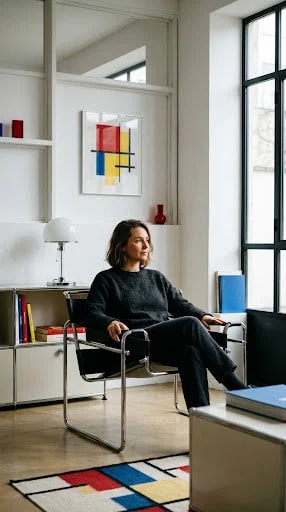
Most photographs of Bauhaus interiors are taken before anyone arrives. The grid is perfect, the chrome gleams, and nothing has been moved. This room is different: someone is already seated, knees drawn up, a book within reach, and the whole composition relaxes around her. That is the honest test of any style — what it looks like once a person settles into it.
The chair does most of the work. A tubular steel frame, bent rather than welded into fussy joints, holding a sling of fabric or leather: Marcel Breuer's logic was that furniture should behave like a bicycle — light, strong, and honest about how it was made. Sitting in one, you feel the difference immediately. It is not a chair that swallows you. It is a chair that lets you sit up and think. Against white walls it reads almost as a drawing, a few black lines and a curve, and it frees the floor in a way that heavy upholstery never can.
What keeps the room from turning clinical is the color discipline. Bauhaus color theory never meant wallpapering a room in primaries; it meant putting them where they count. Here that is a red vase, a blue folder, a printed geometric study on the wall, and a rug laid out in flat blocks of red, yellow, and blue. Four or five saturated moments in an otherwise white and pale-wood field. The eye travels between them and the rest of the space stays calm. Notice also that nothing colorful is large. Scale is what makes primary color sophisticated rather than loud.
Then there is the window. Tall, black-framed, uncurtained, doing the thing the movement cared about most — admitting daylight as a material in its own right. Soft light from the right lifts the white walls into faint gradient and lays a gentle shadow under the shelving. Shelving, by the way, that is modular and open, books visible, objects sparse. Open storage is a Bauhaus habit and a demanding one: it only looks serene when what you own is edited down to things you actually like looking at.
The lesson of a room like this is not that you should buy a steel chair. It is that order and warmth are not opposites. A tight palette, one good window, furniture that shows its structure, and a handful of bright accents will hold a person comfortably for an afternoon. Sit down in it and the geometry stops being a photograph and becomes a place to think.