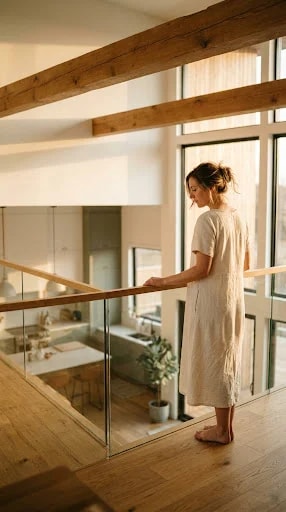
Standing barefoot on the landing, looking down into the kitchen, is a small ritual most two-story homeowners never plan for. The floor between the bedrooms and the stairs is usually treated as circulation — a hallway with a view. But in this home, the landing reads as a destination. Wide-plank oak runs right to the edge, a sheer curtain softens the tall window, and the woman in the beige dress has stopped there, unhurried, as if the ten square feet of floor were the best seat in the house. She is not passing through. She is pausing.
What makes the moment work is the transparency of the edge. A frameless glass panel with a slim wood handrail does two jobs at once: it satisfies safety without building a wall, and it lets the landing borrow the volume of the double-height room below. From above, the kitchen island, the counters, the potted greenery all stay visible — you can hear a kettle, keep an eye on homework, call down a question. From below, the glass keeps the ceiling plane clean, so the exposed beams do the visual talking instead. Those beams matter more than they look. Set at a diagonal, they pull the eye down and across the void, which is exactly the kind of gentle movement a tall interior needs to feel composed rather than cavernous.
The palette holds the calm together. Honey-toned timber on the ceiling, handrail, and floor; cream plaster; a single muted green plant; light that arrives warm and diffuse through the sheer drape. Nothing in the frame competes. That restraint is deliberate — in a two-story space, the architecture is already the loudest element, so the finishes should stay quiet. Notice, too, how the light does the decorating: the golden wash on the far wall and the soft shadows under the rail give the room depth that no amount of styling could fake.
If you have a landing like this, treat it as a room. A small armchair or a bench with a low back, a runner with some weight to it, one lamp on a dimmer — enough to make the spot usable in the evening, when the kitchen glow comes up from below. Check the railing height against local code before you fall in love with a glass panel, and think about sound, since open voids carry conversation in both directions. A rug and a textile or two will take the edge off.
Done well, the landing becomes the place where the house slows down. Coffee in hand, feet on warm wood, the day not quite started. That is not leftover space. That is the point.